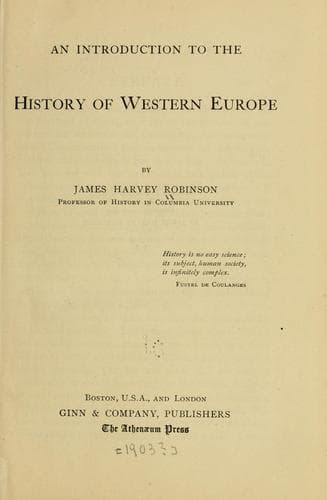
An Introduction to the History of Western EuropeRobinson, James Harvey
History
An Introduction to the History of Western Europe
Robinson, James Harvey
Europe -- History
39. In the absence of a powerful king with a well-organized army at his
back, each district was left to look out for itself. Doubtless many
counts, margraves, bishops, and other great landed proprietors who were
gradually becoming independent princes, earned the loyalty of the people
about them by taking the lead in defending the country against its
invaders and by establishing fortresses as places of refuge when the
community was hard pressed. These conditions serve to explain why such
government as continued to exist during the centuries following the
deposition of Charles the Fat was necessarily carried on mainly, not by
the king and his officers, but by the great landholders. The grim
fortresses of the mediæval lords, which appeared upon almost every point
of vantage throughout western Europe during the Middle Ages, would not
have been tolerated by the king, had he been powerful enough to destroy
them. They plainly indicate that their owners were practically
independent rulers.
When the traveler in France or Germany comes upon the picturesque ruins
of a mediæval castle, perched upon some rocky cliff, accessible from one
side only, and commanding the surrounding country, he cannot but see
that those massive walls, with their towers and battlements, their moat
and drawbridge, were never intended as a dwelling place for the peaceful
household of a private citizen, but rather as the fortified palace of a
ruler. We can picture the great hall crowded with armed retainers, who
were ready to fight for the proprietor when he was disposed to attack a
neighboring lord, and who knew that below were the dungeons to which the
lord might send them if they ventured to rebel against his authority.
[Illustration: Mediæval Fortress, showing Moat and Drawbridges]
[Sidenote: The landed proprietor and the manor.]
In order to understand the position of the mediæval noble and the origin
of feudalism we must consider the situation of the great landowners. A
large part of western Europe in the time of Charlemagne appears to have
been divided up into great estates, resembling the Roman villas. Just
how these originated we do not know. These estates, or _manors_, as they
were called, were cultivated mainly by serfs, who were bound to the land
and were under the control of its proprietor. They tilled such part of
the estate as the owner reserved for his own particular use, and
provided for his needs and their own without the necessity of buying
much from the outside. When we speak of a mediæval landowner we mean one
who held one or more of these manors, which served to support him and
left him free to busy himself fighting with other proprietors in the
same position as himself.[59]
[Sidenote: Immunities.]
Public-domain text, read in full here on John Shaqi.
Reviews
Reviews
No reviews yet
Be the first to share your thoughts on this work.
Elsewhere in the archive
Join the Discussion
Join the discussion
Sign in to leave a comment or review.
Sign InorCreate an account