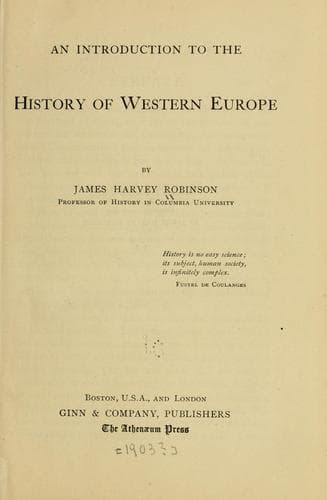
An Introduction to the History of Western EuropeRobinson, James Harvey
History
An Introduction to the History of Western Europe
Robinson, James Harvey
Europe -- History
It had been common even before Charlemagne's time to grant to
monasteries and churches, and even to individuals, an extraordinary
privilege which exempted their lands from the presence or visits of
government officials. No public officer with the power to hear cases,
exact fines, obtain lodging or entertainment for the king and his
followers when traveling about, or make requisitions of any kind, was to
enter the lands or villages belonging to the monastery or person
enjoying the _immunity_. These exemptions were evidently sought with a
view to getting rid of the exactions of the king's officials and
appropriating the various fines and fees, rather than with the purpose
of usurping governmental prerogatives. But the result was that the
monasteries or individuals who were thus freed from the requisitions of
the government were left to perform its functions,--not, however, as yet
in their own right, but as representatives of the king.[60] It is not
hard to see how those who enjoyed this privilege might, as the central
power weakened, become altogether independent. It is certain that a
great many landowners who had been granted no exemption from the
jurisdiction of the king's officers, and a great many of the officers
themselves, especially the counts and margraves, gradually broke away
altogether from the control of those above them and became the rulers of
the regions in which they lived.
[Sidenote: Tendency to hereditary offices.]
The counts were in a particularly favorable position to usurp for their
own benefit the powers which they were supposed to exercise for the
king. Charlemagne had chosen his counts and margraves in most cases from
the wealthy and distinguished families of his realms. As he had little
money, he generally rewarded their services by grants of estates, which
only served to increase their independence. They gradually came to look
upon their office and their land as private property, and they were
naturally disposed to hand it on to their sons after them. Charlemagne
had been able to keep control of his agents by means of the _missi_.
After his death his system fell into disuse and it became increasingly
difficult to get rid of inefficient or rebellious officers.
[Sidenote: Forces opposed to disruption, viz., partial survival of royal
authority and feudalism.]
Public-domain text, read in full here on John Shaqi.
Reviews
Reviews
No reviews yet
Be the first to share your thoughts on this work.
Elsewhere in the archive
Join the Discussion
Join the discussion
Sign in to leave a comment or review.
Sign InorCreate an account