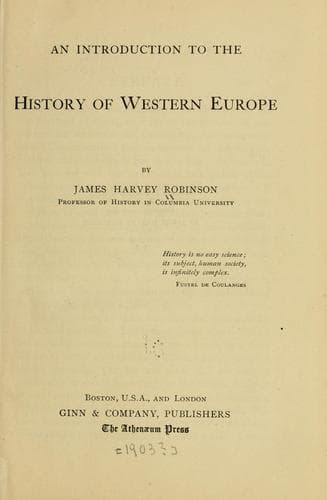
An Introduction to the History of Western EuropeRobinson, James Harvey
History
An Introduction to the History of Western Europe
Robinson, James Harvey
Europe -- History
Yet we must not infer that the state ceased to exist altogether during
the centuries of confusion that followed the break-up of Charlemagne's
empire, or that it fell entirely apart into little local governments
independent of each other. In the first place, a king always retained
some of his ancient majesty. He might be weak and without the means to
enforce his rights and to compel his more powerful subjects to meet
their obligations toward him. Yet he was, after all, the _king_,
solemnly anointed by the Church as God's representative on earth. He was
always something more than a feudal lord. The kings were destined to get
the upper hand before many centuries in England, France, and Spain, and
finally in Italy and Germany, and to destroy the castles behind whose
walls their haughty nobles had long defied the royal power.
[Sidenote: Feudalism.]
In the second place, the innumerable independent landowners were held
together by _feudalism_. One who had land to spare granted a portion of
it to another person on condition that the one receiving the land should
swear to be true to him and perform certain services,--such as fighting
for him, giving him counsel, and lending aid when he was in particular
difficulties. In this way the relation of lord and vassal originated.
All lords were vassals either of the king or of other lords, and
consequently all were bound together by solemn engagements to be loyal
to one another and care for one another's interests. Feudalism served
thus as a sort of substitute for the state. Private arrangements between
one landowner and another took the place of the weakened bond between
the subject and his king.
The feudal form of government and the feudal system of holding land are
so different from anything with which we are now familiar that it is
difficult for us to understand them. Yet unless we do understand them, a
great part of the history of Europe during the past thousand years will
be well-nigh meaningless.[61]
CHAPTER IX
FEUDALISM
[Sidenote: Feudalism the outgrowth of prevailing conditions and earlier
customs.]
40. Feudalism was the natural outcome of the peculiar conditions which
prevailed in western Europe during the ninth and tenth centuries. Its
chief elements were not, however, newly invented or discovered at that
period but were only combined in order to meet the demands of the times.
It will be well, therefore, to consider briefly those customs in the
later Roman Empire and among the invading Germans which suggest (1) the
habit of the mediæval landowner of granting his land to others in such a
way that, while he retained the title, they became, to most intents and
purposes, the real owners; and (2) the relation of lord and vassal.
[Sidenote: Conditions of landholding in the later Roman Empire.]
[Sidenote: The _beneficium_.]
Public-domain text, read in full here on John Shaqi.
Reviews
Reviews
No reviews yet
Be the first to share your thoughts on this work.
Elsewhere in the archive
Join the Discussion
Join the discussion
Sign in to leave a comment or review.
Sign InorCreate an account