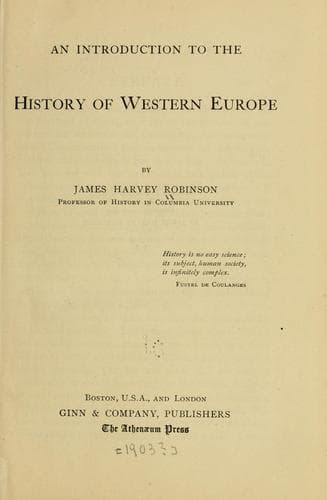
An Introduction to the History of Western EuropeRobinson, James Harvey
History
An Introduction to the History of Western Europe
Robinson, James Harvey
Europe -- History
[Sidenote: Combination of the _comitatus_ and the _beneficium_ produces
feudal land tenure.]
While there was a great difference between the homeless and destitute
fellow who became the humble client of a rich Roman landowner, and the
noble young German warrior who sat at the board of a distinguished
military leader, both of these help to account for the later feudal
arrangement by which one person became the "man," or faithful and
honorable dependent, of another. When, after the death of Charlemagne,
men began to combine the idea of the _comitatus_ with the idea of the
_beneficium_, and to grant the usufruct of parcels of their land on
condition that the grantee should be true, loyal, and helpful to them,
that is, become their _vassal_, we may consider that the feudal system
of landowning was coming into existence.[65]
[Sidenote: Gradual development of feudalism.]
[Sidenote: The fief.]
[Sidenote: Infeudation and subinfeudation.]
[Sidenote: Vassal and subvassal.]
41. Feudalism was not established by any decree of a king or in virtue
of any general agreement between all the landowners. It grew up
gradually and irregularly without any conscious plan on any one's part,
simply because it seemed convenient and natural under the circumstances.
The owner of vast estates found it to his advantage to parcel them out
among vassals who agreed to accompany him to war, attend his court,
guard his castle upon occasion, and assist him when he was put to any
unusually great expense. Land granted upon the terms mentioned was said
to be "infeudated" and was called a _fief_. One who held a fief might
himself become a lord by granting a portion of his fief to a vassal upon
terms similar to those upon which he held of his lord or suzerain.[66]
This was called _subinfeudation_, and the vassal of a vassal was called
a _subvassal_ or _subtenant_. There was still another way in which the
number of vassals was increased. The owners of small estates were
usually in a defenseless condition, unable to protect themselves against
the insolence of the great nobles. They consequently found it to their
advantage to put their land into the hands of a neighboring lord and
receive it back from him as a fief. They thus became his vassals and
could call upon him for protection.
Public-domain text, read in full here on John Shaqi.
Reviews
Reviews
No reviews yet
Be the first to share your thoughts on this work.
Elsewhere in the archive
Join the Discussion
Join the discussion
Sign in to leave a comment or review.
Sign InorCreate an account