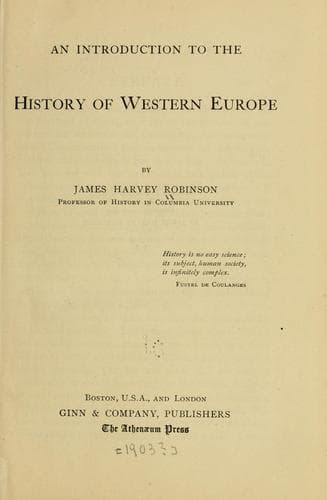
An Introduction to the History of Western EuropeRobinson, James Harvey
History
An Introduction to the History of Western Europe
Robinson, James Harvey
Europe -- History
It is apparent, from what has been said, that, all through the Middle
Ages, feudalism continued to grow, as it were, "from the top and bottom
and in the middle all at once." (1) Great landowners carved out new
fiefs from their domains and granted them to new vassals. (2) Those who
held small tracts brought them into the feudal relation by turning them
over to a lord or monastery, whose vassals they became. (3) Finally any
lord might subinfeudate portions of his estate by granting them as fiefs
to those whose fidelity or services he wished to secure. By the
thirteenth century it had become the rule in France that there should be
"no land without its lord." This corresponded pretty closely to the
conditions which existed at that period throughout the whole of western
Europe.
[Sidenote: The hereditary character of fiefs and its consequences.]
It is essential to observe that the fief, unlike the _beneficium_, was
not granted for a certain number of years, or for the life of the
grantee, to revert at his death to the owner. On the contrary, it became
hereditary in the family of the vassal and passed down to the eldest son
from one generation to another. So long as the vassal remained faithful
to his lord and performed the stipulated services, and his successors
did homage and continued to meet the conditions upon which the fief had
originally been granted, neither the lord nor his heirs could rightfully
regain possession of the land. No precise date can be fixed at which it
became customary to make fiefs hereditary; it is safe, however, to say
that it was the rule in the tenth century.[67]
The kings and great nobles perceived clearly enough the disadvantage of
losing control of their lands by permitting them to become hereditary
property in the families of their vassals. But the feeling that what the
father had enjoyed should pass to his children, who, otherwise, would
ordinarily have been reduced to poverty, was so strong that all
opposition on the part of the lord proved vain. The result was that
little was left to the original and still nominal owner of the fief
except the services and dues to which the practical owner, the vassal,
had agreed in receiving it. In short, the fief came really to belong to
the vassal, and only a shadow of his former proprietorship remained in
the hands of the lord. Nowadays the owner of land either makes some use
of it himself or leases it for a definite period at a fixed money rent.
But in the Middle Ages most of the land was held by those who neither
really owned it nor paid a regular rent for it and yet who could not be
deprived of it by the original owner or his successors.
[Sidenote: Subvassals of the king not under his control.]
Public-domain text, read in full here on John Shaqi.
Reviews
Reviews
No reviews yet
Be the first to share your thoughts on this work.
Elsewhere in the archive
Join the Discussion
Join the discussion
Sign in to leave a comment or review.
Sign InorCreate an account