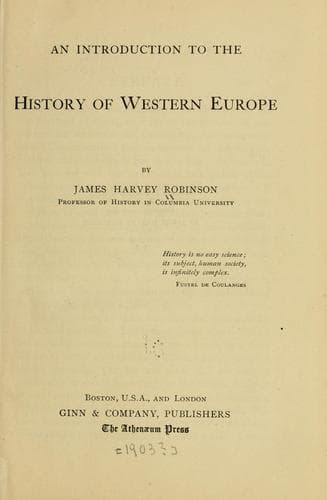
An Introduction to the History of Western EuropeRobinson, James Harvey
History
An Introduction to the History of Western Europe
Robinson, James Harvey
Europe -- History
Of these subnations none was more important or interesting than
Normandy. The Northmen had been the scourge of those who lived near the
North Sea for many years before one of their leaders, Rollo (or Hrolf),
agreed to accept from Charles the Simple (in 911) a district on the
coast, north of Brittany, where he and his followers might peacefully
settle. Rollo assumed the title of Duke of the Normans and introduced
the Christian religion among his people. For a considerable time the
newcomers kept up their Scandinavian traditions and language. Gradually,
however, they appropriated such culture as their neighbors possessed,
and by the twelfth century their capital, Rouen, was one of the most
enlightened cities of Europe. Normandy became a source of infinite
perplexity to the French kings when, in 1066, Duke William the Conqueror
added England to his possessions; for he thereby became so powerful that
his suzerain could hardly hope to control the Norman dukes any longer.
[Sidenote: Brittany.]
The isolated peninsula of Brittany, inhabited by a Celtic people of the
same race as the early inhabitants of Britain, had been particularly
subject to the attacks of the Scandinavian pirates. It seemed at one
time as if the district would become an appendage of Normandy. But in
938 a certain valiant Alain of the Twisted Beard arose to deliver it
from the oppression of the strangers. The Normans were driven out, and
feudalism replaced the older tribal organization in what was hereafter
to be called the duchy of Brittany. It was not until the opening of the
sixteenth century that this became a part of the French monarchy.
[Sidenote: Origin of the Flemish towns.]
The pressure of the Northmen had an important result in the low
countries between the Somme and the Scheldt. The inhabitants were driven
to repair and seek shelter in the old Roman fortifications. They thus
became accustomed to living in close community, and it was in this way
that the Flemish towns--Ghent, Bruges, etc.--originated, which became in
time famous centers of industry and trade. The founders of the great
families of the district first gained their influence in defending the
country against the Scandinavian pirates. The counts of Flanders aspired
to rule the region, but the lesser counts within their territory were
pretty independent of them; so private wars were frequent and bloody.
[Sidenote: Burgundy.]
Public-domain text, read in full here on John Shaqi.
Reviews
Reviews
No reviews yet
Be the first to share your thoughts on this work.
Elsewhere in the archive
Join the Discussion
Join the discussion
Sign in to leave a comment or review.
Sign InorCreate an account