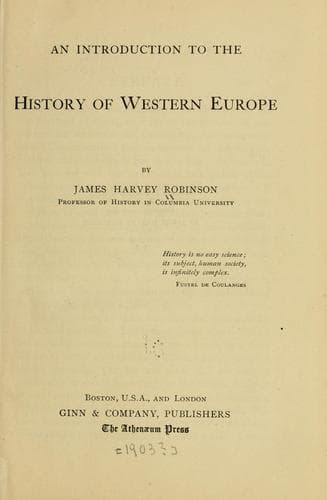
An Introduction to the History of Western EuropeRobinson, James Harvey
History
An Introduction to the History of Western Europe
Robinson, James Harvey
Europe -- History
Burgundy is a puzzling name because it is applied to several different
parts of the territory once included in the kingdom founded by the
Burgundians, which Clovis made tributary to his expanding Frankish
kingdom. Toward the end of the ninth century we first hear of a _duke_
of Burgundy as being appointed military representative of the king (as
all dukes originally were) in a large district west of the Saône. The
dukes of Burgundy never succeeded in establishing sufficient control
over their vassals to render themselves independent, and consequently
they always freely recognized the sovereignty of the French kings. We
shall meet the name Burgundy later.
[Sidenote: Possessions of the duke of Aquitaine and of the counts of
Toulouse and Champagne.]
The ancient duchy of Aquitaine (later Guienne), including a large part
of what is now central and southern France, was abolished in 877, but
the title of Duke of Aquitaine was conferred by the king upon a certain
family of feudal lords, who gradually extended their power over Gascony
and northward. To the southeast, the counts of Toulouse had begun to
consolidate a little state which was to be the seat of the extraordinary
literature of the troubadours. The county of Champagne has already been
considered in the discussion of feudalism.
This completes the survey of the countries over which Hugh Capet and his
immediate successors strove to rule. All those districts to the east of
the Saône and the Rhone which now form a part of France were amalgamated
(in 933) into the kingdom of Arles, or Burgundy,[77] which in 1032 fell
into the hands of the German king.
[Sidenote: Complicated position of the Capetian kings.]
48. The position of the Capetian rulers was a complicated one. As counts
of Paris, Orleans, etc., they enjoyed the ordinary rights of a feudal
lord; as dukes of France, they might exercise a vague control over the
district north of the Seine; as suzerains of the great feudal
princes,--the duke of Normandy, the counts of Flanders, Champagne, and
the rest,--they might require homage and certain feudal services from
these great personages. But besides all these rights as feudal lords
they had other rights as kings. They were crowned and consecrated by the
Church, as Pippin and Charlemagne had been. They thus became, by God's
appointment, the protectors of the Church and the true fountain of
justice for all who were oppressed or in distress throughout their
realms. Therefore they were on a higher plane in the eyes of the people
than any of the great vassals. Besides the homage of their vassals, they
exacted an oath of fidelity from all whom they could reach.
Public-domain text, read in full here on John Shaqi.
Reviews
Reviews
No reviews yet
Be the first to share your thoughts on this work.
Elsewhere in the archive
Join the Discussion
Join the discussion
Sign in to leave a comment or review.
Sign InorCreate an account