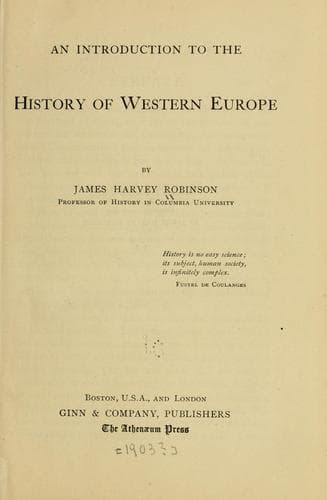
An Introduction to the History of Western EuropeRobinson, James Harvey
History
An Introduction to the History of Western Europe
Robinson, James Harvey
Europe -- History
The great vassals, on the other hand, acted on the theory that the king
was simply their feudal lord. As for the king himself, he accepted both
views of his position and made use both of the older theory of kingship
and of his feudal suzerainty to secure more and more control over his
realms. For over three hundred years the direct male line of the
Capetians never once failed. It rarely happened, moreover, that the
crown was left in the weak hands of a child. By the opening of the
fourteenth century there was no doubt that the king, and not the feudal
lords, was destined to prevail.
[Sidenote: Louis the Fat, 1108-1137.]
[Sidenote: Philip Augustus, 1180-1223.]
The first of the kings of France to undertake with success the serious
task of conquering his own duchy was Louis the Fat (1108-1137). He was
an active soldier and strove to keep free the means of communication
between the different centers of his somewhat scattered feudal domains
and to destroy the power of the usurping castellans in his fortresses.
But he made only a beginning; it was reserved for his famous grandson,
Philip Augustus (1180-1223), to make the duchy of France into a real
kingdom.
[Sidenote: The Plantagenets in France.]
[Sidenote: Henry II.]
49. Philip had a far more difficult problem to face than any of the
preceding kings of his house. Before his accession a series of those
royal marriages which until recently exercised so great an influence
upon political history, had brought most of the great fiefs of central,
western, and southern France into the hands of the king of England,
Henry II, who now ruled over the most extensive realm in western Europe.
Henry II was the son of William the Conqueror's granddaughter
Matilda,[78] who had married one of the great vassals of the French
kings, the count of Anjou and Maine.[79] Henry, therefore, inherited
through his mother all the possessions of the Norman kings of
England,--namely, England, the duchy of Normandy, and the suzerainty
over Brittany,--and through his father the counties of Maine and Anjou.
Lastly, through his own marriage with Eleanor, the heiress of the dukes
of Guienne (as Aquitaine was now called), he possessed himself of pretty
much all of southern France, including Poitou and Gascony. Henry II, in
spite of his great importance in English history, was as much French as
English, both by birth and sympathies, and gave more than half his time
and attention to his French possessions.
[Sidenote: Philip and the Plantagenets.]
Public-domain text, read in full here on John Shaqi.
Reviews
Reviews
No reviews yet
Be the first to share your thoughts on this work.
Elsewhere in the archive
Join the Discussion
Join the discussion
Sign in to leave a comment or review.
Sign InorCreate an account