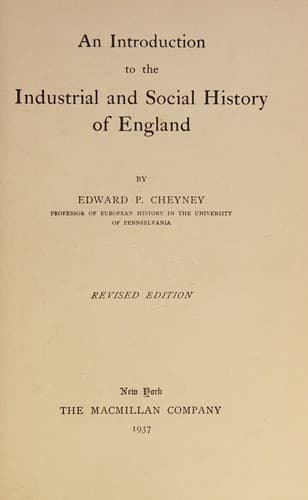
An Introduction to the Industrial and Social History of EnglandCheyney, Edward Potts
History
An Introduction to the Industrial and Social History of England
Cheyney, Edward Potts
Great Britain -- Economic conditions; Great Britain -- Maps; Industries -- Great Britain
Professor Ashley's second volume is of especial value for this period.
Green, Mrs. J. R.: _Town Life in England in the Fifteenth Century_,
two volumes.
Cheyney, E. P.: _Social Changes in England in the Sixteenth Century,
Part I, Rural Changes_.
A discussion of the legal character of villain tenure in the sixteenth
century will be found in articles by Mr. I. S. Leadam, in _The English
Historical Review_, for October, 1893, and in the _Transactions of the
English Royal Historical Society_ for 1892, 1893, and 1894; and by
Professor Ashley in the _English Historical Review_ for April, 1893,
and _Annals of the American Academy of Political Science_ for January,
1891. (Reprinted in _English Economic History_, Vol. II, Chap. 4.)
Bourne, H. R. F.: _English Merchants_.
Froude, J. A.: _History of England_. Many scattered passages of great
interest refer to the economic and social changes of this period, but
they are frequently exaggerated, and in some cases incorrect. Almost
the same remark applies to Professor Rogers' _Six Centuries of Work
and Wages_ and _Industrial and Commercial History of England_.
Busch, Wilhelm: _A History of England under the Tudors_. For the
economic policy of Henry VII.
CHAPTER VII
THE EXPANSION OF ENGLAND
Economic Changes Of The Seventeenth And Early Eighteenth Centuries
*49. National Affairs from 1603 to 1760.*--The last three rulers of the
Tudor family had died childless. James, king of Scotland, their
cousin, therefore inherited the throne and became the first English
king of the Stuart family. James reigned from 1603 to 1625. Many of
the political and religious problems which had been created by the
policy of the Tudor sovereigns had now to come up for solution.
Parliament had long been restive under the almost autocratic
government of Queen Elizabeth, but the danger of foreign invasion and
internal rebellion, long-established habit, Elizabeth's personal
popularity, her age, her sex, and her occasional yielding, all
combined to prevent any very outspoken opposition. Under King James
all these things were changed. Yet he had even higher ideas of his
personal rights, powers, and duties as king than any of his
predecessors. Therefore during the whole of the reign dispute and ill
feeling existed between the king, his ministers, and many of the
judges and other officials, on the one hand, and the majority of the
House of Commons and among the middle and upper classes of the
country, on the other. James would willingly have avoided calling
Parliament altogether and would have carried on the government
according to his own judgment and that of the ministers he selected,
but it was absolutely necessary to assemble it for the passing of
certain laws, and above all for the authorization of taxes to obtain
the means to carry on the government. The fall in the value of gold
and silver and the consequent rise of prices, and other economic
changes, had reduced the income of the government just at a time when
Public-domain text, read in full here on John Shaqi.
Reviews
Reviews
No reviews yet
Be the first to share your thoughts on this work.
Elsewhere in the archive
Join the Discussion
Join the discussion
Sign in to leave a comment or review.
Sign InorCreate an account