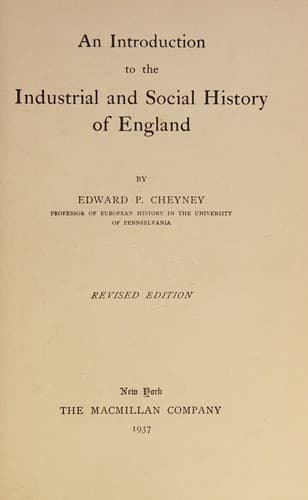
An Introduction to the Industrial and Social History of EnglandCheyney, Edward Potts
History
An Introduction to the Industrial and Social History of England
Cheyney, Edward Potts
Great Britain -- Economic conditions; Great Britain -- Maps; Industries -- Great Britain
its necessary expenses were increasing, and when a spendthrift king
was making profuse additional outlays. Finances were therefore a
constant difficulty during his reign, as in fact they remained during
the whole of the seventeenth century.
In religion James wished to maintain the middle course of the
established church as it had been under Elizabeth. He was even less
inclined to harsh treatment of the Roman Catholics. On the other hand,
the tide of Puritan feeling appealing for greater strictness and
earnestness in the church and a more democratic form of church
government was rising higher and higher, and with this a desire to
expel the Roman Catholics altogether. The House of Commons represented
this strong Protestant feeling, so that still another cause of
conflict existed between King and Parliament. Similarly, in foreign
affairs and on many other questions James was at cross purposes with
the main body of the English nation.
This reign was the period of foundation of England's great colonial
empire. The effort to establish settlements on the North American
coast were at last successful in Virginia and New England, and soon
after in the West Indies. Still other districts were being settled by
other European nations, ultimately to be absorbed by England. On the
other side of the world the East India Company began its progress
toward the subjugation of India. Nearer home, a new policy was carried
out in Ireland, by which large numbers of English and Scotch
immigrants were induced to settle in Ulster, the northernmost
province. Thus that process was begun by which men of English race and
language, living under English institutions and customs, have
established centres of population, wealth, and influence in so many
parts of the world.
Charles I came to the throne in 1625. Most of the characteristics of
the period of James continued until the quarrels between King and
Parliament became so bitter that in 1642 civil war broke out. The
result of four years of fighting was the defeat and capture of the
king. After fruitless attempts at a satisfactory settlement Charles
was brought to trial by Parliament in 1649, declared guilty of
treason, and executed.
Public-domain text, read in full here on John Shaqi.
Reviews
Reviews
No reviews yet
Be the first to share your thoughts on this work.
Elsewhere in the archive
Join the Discussion
Join the discussion
Sign in to leave a comment or review.
Sign InorCreate an account