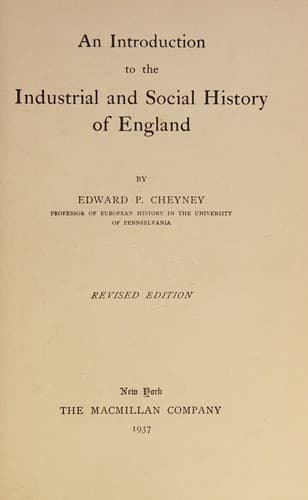
An Introduction to the Industrial and Social History of EnglandCheyney, Edward Potts
History
An Introduction to the Industrial and Social History of England
Cheyney, Edward Potts
Great Britain -- Economic conditions; Great Britain -- Maps; Industries -- Great Britain
*25. Foreigners settled in England.*--The fact that almost all of the
foreign trade of England was in the hands of aliens necessarily
involved their presence in the country temporarily or permanently in
considerable numbers. The closely related fact that the English were
distinctly behind the people of the Continent in economic knowledge,
skill, and wealth also led foreigners to seek England as a field for
profitable exercise of their abilities in finance, in trade, and
manufactures. The most conspicuous of these foreigners at the close of
the thirteenth century and during the early part of the fourteenth
were the Italian bankers. Florence was not only a great trading and
manufacturing city, but a money centre, a capitalist city. The Bardi,
Peruzzi, Alberti, Frescobaldi, and other banking companies received
deposits from citizens of Florence and other Italian cities, and
loaned the money, as well as their own capital, to governments, great
nobles, and ecclesiastical corporations in other countries. When the
Jews were expelled from England in 1290, there being no considerable
amount of money among native Englishmen, the Italian bankers were the
only source from which the government could secure ready money. When a
tax had been authorized by Parliament, but the product of it could be
obtained only after a year or more spent in its collection, the
Florentines were at hand to offer the money at once, receiving
security for repayment when the receipts from the tax should come in.
Government monopolies like the Cornwall tin mines were leased to them
for a lump sum; arrangements were made by which the bankers furnished
a certain amount of money each day during a campaign or a royal
progress. The immediate needs of an impecunious king were regularly
satisfied with money borrowed to be repaid some months afterward. The
equipment for all of the early expeditions of the Hundred Years' War
was obtained with money borrowed from the Florentines. Payments abroad
were also made by means of bills of exchange negotiated by the same
money-lenders. Direct payment of interest was forbidden by law, but
they seem to have been rewarded by valuable government concessions, by
the profits on exchange, and no doubt by the indirect payment of
interest, notwithstanding its illegality.
Public-domain text, read in full here on John Shaqi.
Reviews
Reviews
No reviews yet
Be the first to share your thoughts on this work.
Elsewhere in the archive
Join the Discussion
Join the discussion
Sign in to leave a comment or review.
Sign InorCreate an account