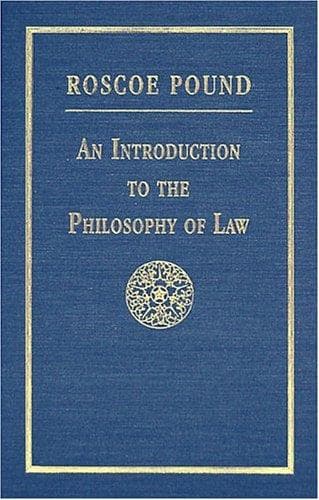
An Introduction to the Philosophy of LawPound, Roscoe
Philosophy
An Introduction to the Philosophy of Law
Pound, Roscoe
Law -- Philosophy
Likewise in civil-law countries the enforcing machinery is modern and
adequate. The oldest method of enforcement in Roman law was seizure of
the person, to coerce satisfaction or hold the promisor in bondage
until his kinsmen performed the judgment. Later there was a pecuniary
condemnation or, as we should say, a money judgment in all cases,
enforced in the classical law by universal execution or, as we should
say, by involuntary bankruptcy. But along with this remedy specific
relief grew up in the _actio arbitraria_, a clumsy device of specific
performance on the alternative of a heavy money condemnation, which
repeated itself in Pennsylvania before equity powers were given the
courts, and is substantially repeating in our federal courts in their
attempts to apply equitable relief to torts committed in foreign
jurisdictions. The civil law developed, or perhaps the canon law
developed and the civil law took over, an _actio ad implendum_ or
action to require performance, with natural execution, that is a doing
by the court or its officers at the expense of the defendant, of that
to which he is bound as ascertained by the judgment. In general in
civil-law countries today what we call specific performance is the
rule. A money reparation for breach of contract is the exceptional
remedy. It is only when for some reason specific relief is
impracticable or inequitable, as in contracts of personal service,
that money relief is resorted to.
In countries governed by the common law we do not secure this interest
so completely nor so effectively. For one thing we do not recognize as
legally enforceable all intentional promises intended to be binding
upon the promisor. Many technical rules as to consideration, rules
having chiefly a historical basis, stand in the way. Many
jurisdictions have abolished private seals and have made no provision
for formal gratuitous or abstract promises. Moreover, we do not give
specific relief ordinarily but only exceptionally where pecuniary
relief is considered inadequate. Hence in the great majority of cases
the promisee cannot compel performance in specie.
If we look into the reasons for this wide and effective enforcement
of promises in the one system and narrower and less effective
enforcement in the other, we come in both cases upon a mixture of
historical background and philosophical reasoning, each influencing
the other and neither governing the subject completely. Philosophical
theories have arisen to explain existing rules and have been the basis
of new rules and of remaking of old ones. But they have been the means
also, at times, of intrenching the rules they sought to explain and of
fastening on the law doctrines of which it were better rid. Nowhere is
the reciprocal action of legal rules and philosophical theories more
strikingly manifest than in our law of contractual liability.
Public-domain text, read in full here on John Shaqi.
Reviews
Reviews
No reviews yet
Be the first to share your thoughts on this work.
Elsewhere in the archive
Join the Discussion
Join the discussion
Sign in to leave a comment or review.
Sign InorCreate an account