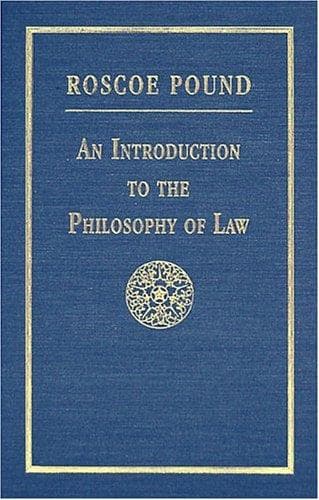
An Introduction to the Philosophy of LawPound, Roscoe
Philosophy
An Introduction to the Philosophy of Law
Pound, Roscoe
Law -- Philosophy
Wealth, in a commercial age, is made up largely of promises. An
important part of everyone's substance consists of advantages which
others have promised to provide for or to render to him; of demands to
have the advantages promised which he may assert not against the world
at large but against particular individuals. Thus the individual
claims to have performance of advantageous promises secured to him. He
claims the satisfaction of expectations created by promises and
agreements. If this claim is not secured friction and waste obviously
result, and unless some countervailing interest must come into account
which would be sacrificed in the process, it would seem that the
individual interest in promised advantages should be secured to the
full extent of what has been assured to him by the deliberate promise
of another. Let us put this in another way. In a former lecture I
suggested, as a jural postulate of civilized society, that in such a
society men must be able to assume that those with whom they deal in
the general intercourse of the society will act in good faith, and as
a corollary must be able to assume that those with whom they so deal
will carry out their undertakings according to the expectations which
the moral sentiment of the community attaches thereto. Hence, in a
commercial and industrial society, a claim or want or demand of
society that promises be kept and that undertakings be carried out in
good faith, a social interest in the stability of promises as a social
and economic institution, becomes of the first importance. This social
interest in the security of transactions, as one might call it,
requires that we secure the individual interest of the promisee, that
is, his claim or demand to be assured in the expectation created,
which has become part of his substance.
In civil-law countries the interest of the promisee, and thus the
social interest in the security of transactions, is well secured. The
traditional requirement of a _causa ciuilis_, a civil, i.e., legal,
reason for enforcing a pact, gave way before natural-law ideas in the
eighteenth century. Pothier gave over the contract categories of the
Roman law as being "very remote from simplicity." Then came the rise
of the will theory of legal transactions in the nineteenth century.
French law made intention of gratuitously benefiting another a
_causa_. The Austrian code of 1811 presumed a _causa_, requiring a
promisor to prove there was none. And this means that he must prove
the promise was not a legal transaction--that there was no intention
to enter into a binding undertaking. In the result, abstract promises,
as the civilian calls them, came to be enforced equally with those
which came under some formal Roman category and with those having a
substantial presupposition. Modern Continental law, apart from certain
requirements of proof, resting on the same policy as our Statute of
Frauds, asks only, Did the promisor intend to create a binding duty?
Public-domain text, read in full here on John Shaqi.
Reviews
Reviews
No reviews yet
Be the first to share your thoughts on this work.
Elsewhere in the archive
Join the Discussion
Join the discussion
Sign in to leave a comment or review.
Sign InorCreate an account