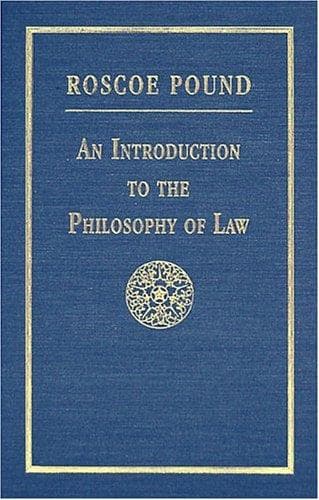
An Introduction to the Philosophy of LawPound, Roscoe
Philosophy
An Introduction to the Philosophy of Law
Pound, Roscoe
Law -- Philosophy
Greek philosophers came to conceive of the general security in broader
terms and to think of the end of the legal order as preservation of
the social _status quo_. They came to think of maintaining the general
security mediately through the security of social institutions. They
thought of law as a device to keep each man in his appointed groove in
society and thus prevent friction with his fellows. The virtue on
which they insisted was _sophrosyne_, knowing the limits which nature
fixes for human conduct and keeping within them. The vice which they
denounced was _hybris_, wilful bondbreaking--wilful transgression of
the socially appointed bounds. This mode of thinking follows the
substitution of the city-state political organization of society for
the kin-organization. The organized kindreds were still powerful. An
aristocracy of the kin-organized and kin-conscious, on the one hand,
and a mass of those who had lost or severed their ties of kinship, or
had come from without, on the other hand, were in continual struggle
for social and political mastery. Also the politically ambitious
individual and the masterful aristocrat were continually threatening
the none too stable political organization through which the general
security got a precarious protection. The chief social want, which no
other social institution could satisfy, was the security of social
institutions generally. In the form of maintenance of the social
_status quo_ this became the Greek and thence the Roman and medieval
conception of the end of law.
Public-domain text, read in full here on John Shaqi.
Reviews
Reviews
No reviews yet
Be the first to share your thoughts on this work.
Join the Discussion
Join the discussion
Sign in to leave a comment or review.
Sign InorCreate an account