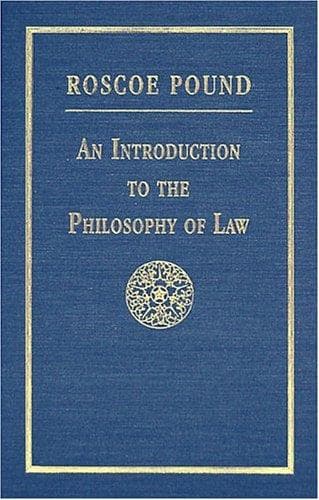
An Introduction to the Philosophy of LawPound, Roscoe
Philosophy
An Introduction to the Philosophy of Law
Pound, Roscoe
Law -- Philosophy
philosophy has done for some of the chief problems of the science of
law, what stands before us to be done in some of the more conspicuous
problems of that science today in which philosophy may help us, and
how it is possible to look at those problems philosophically without
treating them in terms of the eighteenth-century natural law or the
nineteenth-century metaphysical jurisprudence which stand for
philosophy in the general understanding of lawyers.
ROSCOE POUND.
Harvard Law School,
October 25, 1921.
Contents
I. The Function of Legal Philosophy 15
II. The End of Law 59
III. The Application of Law 100
IV. Liability 144
V. Property 191
VI. Contract 236
Bibliography 285
Index 309
I
The Function of Legal Philosophy
For twenty-four hundred years--from the Greek thinkers of the fifth
century B. C., who asked whether right was right by nature or only by
enactment and convention, to the social philosophers of today, who
seek the ends, the ethical basis and the enduring principles of social
control--the philosophy of law has taken a leading rôle in all
study of human institutions. The perennial struggle of American
administrative law with nineteenth-century constitutional formulations
of Aristotle's threefold classification of governmental power, the
stone wall of natural rights against which attempts to put an end to
private war in industrial disputes thus far have dashed in vain, and
the notion of a logically derivable super-constitution, of which
actual written constitutions are faint and imperfect reflections,
which has been a clog upon social legislation for a generation, bear
daily witness how thoroughly the philosophical legal thinking of the
past is a force in the administration of justice of the present.
Indeed, the everyday work of the courts was never more completely
shaped by abstract philosophical ideas than in the nineteenth century
when lawyers affected to despise philosophy and jurists believed they
had set up a self-sufficient science of law which stood in no need of
any philosophical apparatus.
Public-domain text, read in full here on John Shaqi.
Reviews
Reviews
No reviews yet
Be the first to share your thoughts on this work.
Join the Discussion
Join the discussion
Sign in to leave a comment or review.
Sign InorCreate an account