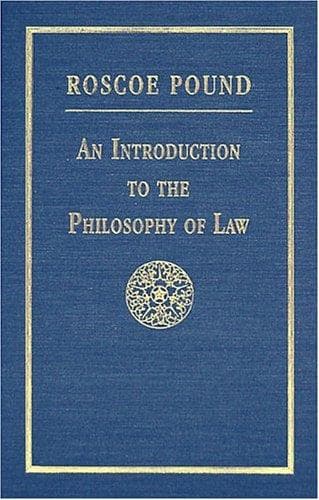
An Introduction to the Philosophy of LawPound, Roscoe
Philosophy
An Introduction to the Philosophy of Law
Pound, Roscoe
Law -- Philosophy
sought to put the duties of public utilities in the form of definite
rules with a detailed, authoritatively fixed content. All these
attempts to do away with the margin of application involved in legal
standards broke down. The chief result was a reaction in the course of
which many states turned over all questions of negligence to juries,
free even from effective advice from the bench, while many other
jurisdictions have been turning over subject after subject to
administrative boards and commissions to be dealt with for a season
without law. In any event, whether the standard of due care in an
action for negligence is applying by a jury, or the standard of
reasonable facilities for transportation is applying by a public
service commission, the process is one of judging of the quality of a
bit of conduct under its special circumstances and with reference to
ideas of fairness entertained by the layman or the ideas of what is
reasonable entertained by the more or less expert commissioner. Common
sense, experience and intuition are relied upon, not technical rule
and scrupulously mechanical application.
We are familiar with judicial individualization in the administration
of equitable remedies. Another form, namely, individualization through
latitude of application under the guise of choice or ascertainment of
a rule, is concealed by the fiction of the logical completeness of the
legal system and the mechanical, logical infallibility of the logical
process whereby the predetermined rules implicit in the given legal
materials are deduced and applied. To a large and apparently growing
extent the practice of our application of law has been that jurors or
courts, as the case may be, take the rules of law as a general guide,
determine what the equities of the cause demand, and contrive to find
a verdict or render a judgment accordingly, wrenching the law no more
than is necessary. Many courts today are suspected of ascertaining
what the equities of a controversy require, and then raking up
adjudicated cases to justify the result desired. Often formulas are
conveniently elastic so that they may or may not apply. Often rules of
contrary tenor overlap, leaving a convenient no-man's-land wherein
cases may be decided either way according to which rule the court
chooses in order to reach a result arrived at on other grounds.
Occasionally a judge is found who acknowledges frankly that he looks
chiefly at the ethical situation between the parties and does not
allow the law to interfere therewith beyond what is inevitable.
Public-domain text, read in full here on John Shaqi.
Reviews
Reviews
No reviews yet
Be the first to share your thoughts on this work.
Elsewhere in the archive
Join the Discussion
Join the discussion
Sign in to leave a comment or review.
Sign InorCreate an account