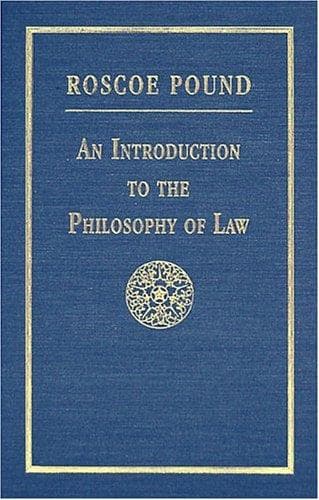
An Introduction to the Philosophy of LawPound, Roscoe
Philosophy
An Introduction to the Philosophy of Law
Pound, Roscoe
Law -- Philosophy
Thus we have in fact a crude equitable application, a crude
individualization, throughout the field of judicial administration of
justice. It is assumed by courts more widely than we suspect, or at
least, more widely than we like to acknowledge. Ostensibly there is no
such power. But when one looks beneath the surface of the law reports,
the process reveals itself under the name of "implication" or in the
guise of two lines of decisions of the same tribunal upon the same
point from which it may choose at will, or in the form of what have
been termed "soft spots" in the law--spots where the lines are so
drawn by the adjudicated cases that the court may go either way as the
ethical exigencies of the special circumstances of the case in hand
may require, with no apparent transgression of what purport to be hard
and fast rules. Such has been the result of attempts to exclude the
administrative element in adjudication. In theory there is no such
thing except with respect to equitable remedies, where it exists for
historical reasons. In practice there is a great deal of it, and that
in a form which is unhappily destructive of certainty and uniformity.
Necessary as it is, the method by which we attain a needed
individualization is injurious to respect for law. If the courts do
not respect the law, who will? There is no exclusive cause of the
current American attitude toward the law. But judicial evasion and
warping of the law, in order to secure in practice a freedom of
judicial action not conceded in theory, is certainly one cause. We
need a theory which recognizes the administrative element as a
legitimate part of the judicial function and insists that
individualization in the application of legal precepts is no less
important than the contents of those precepts themselves.
Public-domain text, read in full here on John Shaqi.
Reviews
Reviews
No reviews yet
Be the first to share your thoughts on this work.
Elsewhere in the archive
Join the Discussion
Join the discussion
Sign in to leave a comment or review.
Sign InorCreate an account