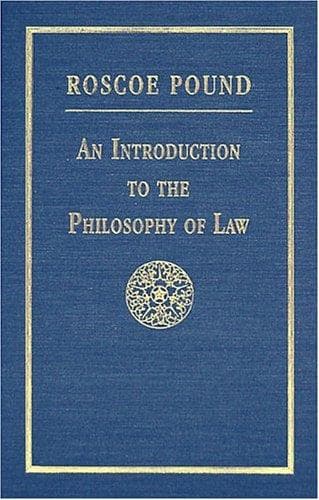
An Introduction to the Philosophy of LawPound, Roscoe
Philosophy
An Introduction to the Philosophy of Law
Pound, Roscoe
Law -- Philosophy
from the present to utilize them for the purposes of today.
We know Greek law from the beginnings of a legal order as pictured
in the Homeric poems to the developed commercial institutions of the
Hellenistic period. In its first stage the kings decide particular
causes by divine inspiration. In a second stage the customary course
of decision has become a tradition possessed by an oligarchy. Later,
popular demand for publication results in a body of enactment. At
first enactments are no more than declaratory. But it was an easy step
from publication of established custom to publication of changes as if
they were established custom and thus to conscious and avowed changes
and intentional new rules through legislation. The law of Athens in
the fifth and fourth centuries B. C. was a codified tradition eked
out by legislation and individualized in its application through
administration of justice by large popular assemblies. Thus in spite
of formal reduction to writing it preserved the fluidity of primitive
law and was able to afford a philosophy for Roman law in its stage
of equity and natural law--another period of legal fluidity. The
development of a strict law out of codified primitive materials,
which in Rome happily preceded the stage of equity and natural law,
did not take place in the Greek city. Hence the rules of law were
applied with an individualized equity that reminds us of the French
_droit coutumier_--a mode of application which, with all its good
points, must be preceded by a body of strict law, well worked out and
well understood, if its results are to be compatible with the general
security in a complex social order. In Athens of the classical period
the word [Greek: nómos], meaning both custom and enacted law as well
as law in general, reflected the uncertainty with respect to form and
the want of uniformity in application, which are characteristic of
primitive law, and invited thought as to the reality behind such
confusion.
Public-domain text, read in full here on John Shaqi.
Reviews
Reviews
No reviews yet
Be the first to share your thoughts on this work.
Join the Discussion
Join the discussion
Sign in to leave a comment or review.
Sign InorCreate an account