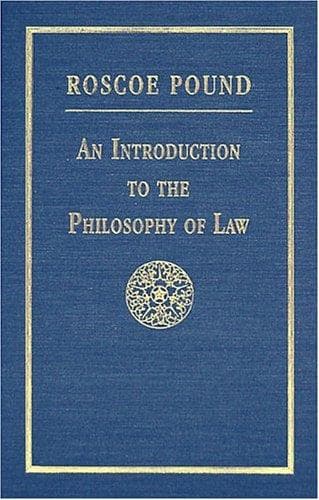
An Introduction to the Philosophy of LawPound, Roscoe
Philosophy
An Introduction to the Philosophy of Law
Pound, Roscoe
Law -- Philosophy
One's neighbor whom one had injured or who had been injured by those
whom one harbored was not the only personality that might desire
vengeance in a primitive society. One might affront the gods, and by
one's impiety in so doing might imperil the general security, since
the angered gods were not unlikely to hit out indiscriminately and to
cast pestilence or hurl lightning upon just and unjust alike in the
community which harbored the impious wrongdoer. Hence if, in making a
promise, one called the gods to witness it was needful that
politically organized society, taking over a field of social control
exercised by the priesthood, give a legal remedy to the promisee lest
he invoke the aid of the gods and jeopardize the general security.
Again in making a promise one might call the people or the
neighborhood to witness and might affront them by calling them to
witness in vain. Here, too, the peace was threatened and politically
organized society might give a remedy to the promisee, lest he invoke
the help of his fellow citizens or his neighbors. A common case might
be one where a composition was promised in this way for an injury not
included in the detailed tariff of compositions that is the staple of
ancient "codes." Another common case was where one who held another's
property for some temporary purpose promised to return it. Such a case
is lending; for before the days of coined money, the difference
between lending a horse to go to the next town and lending ten sheep
to enable the borrower to pay a composition is not perceptible. Thus
another starting point of liability is recovery of a thing certain, or
what was originally the same, a sum certain, promised in such wise as
to endanger the general security if the promise is not carried out. In
Roman law, the condiction, which is the type of actions _in personam_,
and thus the starting point historically of rights _in personam_ and
of theories of obligation, was at first a recovery of a thing certain
or a sum certain due upon a promise of this sort. In juristic terms,
the central idea of the beginnings of liability is duty to make
composition for or otherwise avert wrath arising from the affronted
dignity of some personality desirous of vengeance, whether an injured
individual, a god or a politically organized society. Greek law and
Roman law give the name of "insult" to legally cognizable injury to
personality. Insult to a neighbor by injury to him or to one of his
household, insult to the gods by impious breach of the promise they
had witnessed, insult to the people by wanton disregard of the
undertaking solemnly made in their presence, threatened the peace and
order of society and called for legal remedy.
Public-domain text, read in full here on John Shaqi.
Reviews
Reviews
No reviews yet
Be the first to share your thoughts on this work.
Elsewhere in the archive
Join the Discussion
Join the discussion
Sign in to leave a comment or review.
Sign InorCreate an account