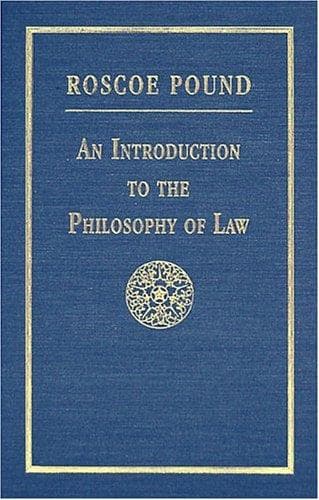
An Introduction to the Philosophy of LawPound, Roscoe
Philosophy
An Introduction to the Philosophy of Law
Pound, Roscoe
Law -- Philosophy
Lawyers begin to generalize and to frame conscious theories in the
later part of the stage of the strict law. At first these theories are
analytical rather than philosophical. The attempt is to frame general
formulas by which the rigid rules of the strict law may be reconciled
where they overlap or conflict or may be distinguished in their
application where such overlapping or conflict threatens. By this
time, the crude beginnings of liability in a duty to compound for
insult or affront to man or gods or people, lest they be moved to
vengeance, has developed into liability to answer for injuries caused
by oneself or done by those persons or those things in one's power,
and liability for certain promises made in solemn form. Thus the basis
of liability has become twofold. It rests on the one hand upon duty to
repair injury. It rests on the other hand upon duty to carry out
formal undertakings. It is enough for this stage of legal development
that all cases of liability may be referred to these two types and
that useful distinctions may be reached therefrom. Consideration of
why one should be held to repair injury, and why he should be held to
formal undertakings, belongs to a later stage.
Juristic theory, beginning in the transition from the strict law to
the stage of equity or natural law, becomes a force in the latter
stage. As the relations with which the law must deal become more
numerous and the situations calling for legal treatment become more
complicated, it is no longer possible to have a simple, definite,
detailed rule for every sort of case that can come before a tribunal,
nor a fixed, absolute form for every legal transaction. Hence, under
the leadership of philosophical jurists, men turn to logical
development of the "nature" or ideal form of situations and to ethical
ideas of what "good faith" or "good conscience" demands in particular
relations or transactions. The strict law, relying on rule and form,
took no account of intention as such. The words took effect quite
independently of the thought behind them. But as lawyers began to
reflect and to teach something more than a class or professional
tradition, as they began to be influenced by philosophy to give over
purely mechanical methods and to measure things by reason rather than
by arbitrary will, emphasis shifted from form to substance; from the
letter to the spirit and intent. The statute was thought of as but the
lawmaker's formulation of a principle of natural law. It was not the
_uerba_ that were efficacious, as in the strict law, which had
inherited the primitive faith in the power of words and thought of the
legal formula as if it were a formula of incantation possessing
inherent magical force. It was the _ratio iuris_, which transcended
words and formulas. So also the traditional rule was not a magic
formula discovered by our fathers. It was a customary expression of a
principle of natural law. Likewise the formal transaction was not a
Public-domain text, read in full here on John Shaqi.
Reviews
Reviews
No reviews yet
Be the first to share your thoughts on this work.
Elsewhere in the archive
Join the Discussion
Join the discussion
Sign in to leave a comment or review.
Sign InorCreate an account