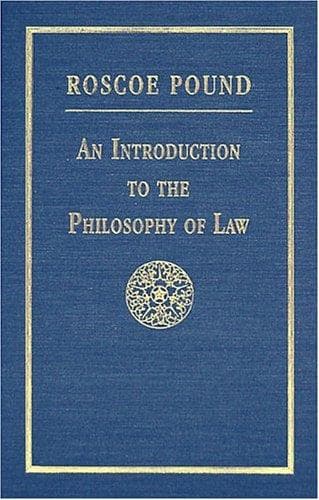
An Introduction to the Philosophy of LawPound, Roscoe
Philosophy
An Introduction to the Philosophy of Law
Pound, Roscoe
Law -- Philosophy
In the nineteenth century the conception of liability as resting on
intention was put in metaphysical rather than ethical form. Law was
a realization of the idea of liberty, and existed to bring about the
widest possible individual liberty. Liberty was the free will in
action. Hence it was the business of the legal order to give the
widest effect to the declared will and to impose no duties except in
order to effectuate the will or to reconcile the will of one with the
will of others by a universal law. What had been a positive, creative
theory of developing liability on the basis of intention, became a
negative, restraining, one might say pruning, theory of no liability
except on the basis of intention. Liability could flow only from
culpable conduct or from assumed duties. The abstract individual will
was the central point in the theory of liability. If one was not
actually culpable and yet established legal precepts which were not to
be denied held him answerable, it was because he was "deemed"
culpable, the historical legal liability being the proof of
culpability. If he had not actually assumed a duty, and yet
established legal precepts which were not to be denied held him to
answer for it, this must be because he had assumed some relation or
professed some calling in which an undertaking to that effect was
"implied" or had participated in some situation in which it was
"implied,"--the implication being a deduction from the liability. The
bases of liability were culpable conduct and legal transaction, and
these came down to an ultimate basis in will. The fundamental
conception in legal liability was the conception of an act--of a
manifestation of the will in the external world.
Public-domain text, read in full here on John Shaqi.
Reviews
Reviews
No reviews yet
Be the first to share your thoughts on this work.
Elsewhere in the archive
Join the Discussion
Join the discussion
Sign in to leave a comment or review.
Sign InorCreate an account