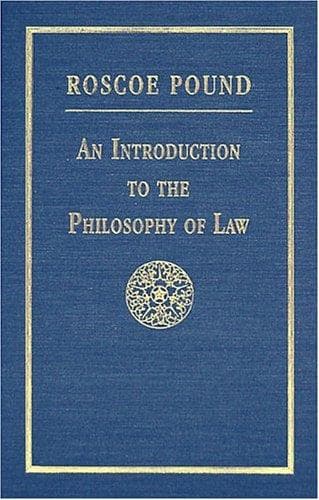
An Introduction to the Philosophy of LawPound, Roscoe
Philosophy
An Introduction to the Philosophy of Law
Pound, Roscoe
Law -- Philosophy
Roman law and English law begin with a set of what might be called
nominate delicts or nominate torts. In Roman law there were _furtum_
(conversion), _rapina_ (forcible conversion) and _iniuria_ (wilful
aggression upon personality). All these involved _dolus_, i.e.
intentional aggression. The _lex Aquilia_ added _damnum iniuria datum_
(wrongful injury to property). Later there were added what might be
called the equitable delicts of _dolus_ (fraud) and _metus_ (duress).
Here also there was wilful aggression, and the delict of _dolus_ gets
its name from the intentional misleading that characterizes it in
Roman law as it does deceit in English law. In _damnum iniuria datum_,
a wider conception of fault, as distinguished from intentional
aggression, grew up by juristic development, and Aquilian _culpa_,
that is, a fault causing injury to property and therefore actionable
on the analogy of the _lex Aquilia_, furnished the model for the
modern law. All these may be fitted to the will theory and modern
systematic writers regularly do so. But noxal liability for injury
done by a child or slave or domestic animal did not fit it, nor did
the liability of a master of a ship, an innkeeper or a stable keeper
to respond without regard to fault. Liability for injury done by child
or slave or domestic animal was enforced in a noxal action on the
analogy of the action which lay for the same injury if done by the
defendant in person. Hence procedurally it seemed liability for a
delict involving intentional aggression, and it was possible to say
that there was fault in not restraining the agency that did the
injury, although no fault had to be shown nor could absence of fault
be shown as a defence. There was fault because there was liability,
for all liability grew out of fault. Such treadings on the tail of its
own argument are very common in legal reasoning. Likewise in the case
of the absolute liability of the master of a ship, the innkeeper and
the stable keeper, the institutional writers could say that they were
at fault in not having proper servants, although here also fault need
not be established by proof nor could want of fault be made a defence.
As procedurally these liabilities arose in actions on the facts of
particular cases, the jurists at first lumped them with many other
forms of liability, which were not in fact dependent on intention and
were enforced in actions _in factum_, as obligations arising from the
special facts of cases (_obligationes ex uariis causarum figuris_).
Later they were called quasi-delictual obligations and they are so
designated in the fourfold classification of the Institutes. Buckland
has remarked that in almost all of the liabilities included under
quasi-delict in the Institutes there is liability at one's peril for
the act of another, especially for one's servant, as in the noxal
actions, the _actio de deiectis et diffusis_ (for things thrown or
poured from buildings upon a way) and the _actio de recepto_ against
Public-domain text, read in full here on John Shaqi.
Reviews
Reviews
No reviews yet
Be the first to share your thoughts on this work.
Elsewhere in the archive
Join the Discussion
Join the discussion
Sign in to leave a comment or review.
Sign InorCreate an account