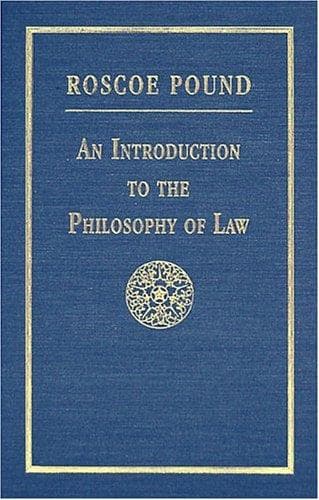
An Introduction to the Philosophy of LawPound, Roscoe
Philosophy
An Introduction to the Philosophy of Law
Pound, Roscoe
Law -- Philosophy
an innkeeper. In other words, in these cases one was held without
regard to fault for injuries incidental to the conduct of certain
enterprises or callings and for failure to restrain potentially
injurious agencies which one maintained.
Modern law has given up both the nominate delicts and quasi-delict, as
things of any significance. The French civil code made the idea of
Aquilian _culpa_ into a general theory of delictal liability, saying,
"Every act of man which causes damage to another obliges him through
whose fault it happened to make reparation." In other words, liability
is to be based on an act, and it must be a culpable act. Act,
culpability, causation, damage, were the elements. This simple theory
of liability for culpable causation of damage was accepted universally
by civilians until late in the nineteenth century and is still
orthodox. Taken up by text writers on torts in the last half of that
century, it had much influence in Anglo-American law. But along with
this generalization the French code preserved a liability without
fault, developed out of the noxal actions, whereby parents and
teachers may be held for injuries by minors under their charge,
masters for injuries by their apprentices, employers for injuries by
employees and those in charge of animals for injuries by such animals.
Also it provided an absolute liability for injury by a _res ruinosa_,
developed out of the Roman _cautio damni infecti_. In the case of
parents, teachers and masters of apprentices, there is only a
presumption of fault. They may escape by showing affirmatively that
they were without fault and that what happened could not have been
prevented by diligence on their part. In the case of employers no
excuse is admitted. The liability is absolute. In the case of
animals, fault of the victim, inevitable accident and _vis maior_ may
be shown affirmatively by way of defence. In the case of a _res
ruinosa_ there is no presumption of fault. But if the structure fell
or did injury because of a defect of construction or want of repair,
the owner is liable absolutely and may not show that he had no notice
of the defect and no reason to suspect it, or that it was not in his
power to prevent the structure from falling.
Public-domain text, read in full here on John Shaqi.
Reviews
Reviews
No reviews yet
Be the first to share your thoughts on this work.
Elsewhere in the archive
Join the Discussion
Join the discussion
Sign in to leave a comment or review.
Sign InorCreate an account