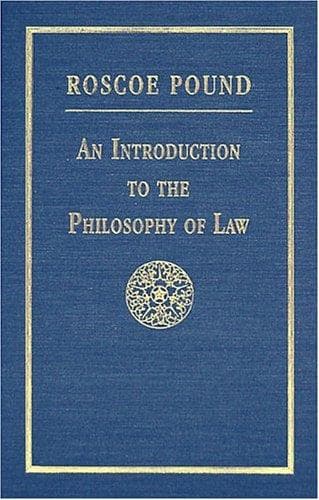
An Introduction to the Philosophy of LawPound, Roscoe
Philosophy
An Introduction to the Philosophy of Law
Pound, Roscoe
Law -- Philosophy
Social-utilitarian theories explain and justify property as an
institution which secures a maximum of interests or satisfies a
maximum of wants, conceiving it to be a sound and wise bit of social
engineering when viewed with reference to its results. This is the
method of Professor Ely's well-known book on Property and Contract. No
one has yet done so, but I suspect one might combine this mode of
thought with the civilization interpretation of the Neo-Hegelians and
argue that the system of individual property, on the whole, conduces
to the maintaining and furthering of civilization--to the development
of human powers to the most of which they are capable--instead of
viewing it as a realization of the idea of civilization as it unfolds
in human experience. Perhaps the theories of the immediate future will
run along some such lines. For we have had no experience of conducting
civilized society on any other basis, and the waste and friction
involved in going to any other basis must give us pause. Moreover,
whatever we do, we must take account of the instinct of
acquisitiveness and of individual claims grounded thereon. We may
believe that the law of property is a wise bit of social engineering
in the world as we know it, and that we satisfy more human wants,
secure more interests, with a sacrifice of less thereby than by
anything we are likely to devise--we may believe this without holding
that private property is eternally and absolutely necessary and that
human society may not expect in some civilization, which we cannot
forecast, to achieve something different and something better.
VI
Contract
Public-domain text, read in full here on John Shaqi.
Reviews
Reviews
No reviews yet
Be the first to share your thoughts on this work.
Elsewhere in the archive
Join the Discussion
Join the discussion
Sign in to leave a comment or review.
Sign InorCreate an account