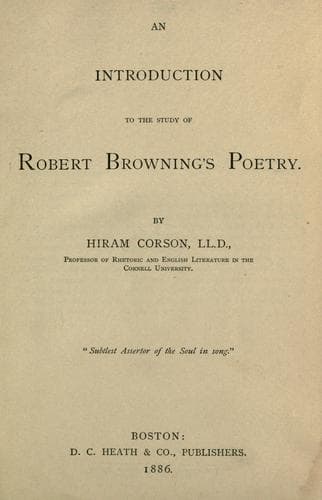
The purpose of the present volume is to afford some aid and guidance
in the study of Robert Browning’s Poetry, which, being the most
complexly subjective of all English poetry, is, for that reason alone,
the most difficult. And then the poet’s favorite art-form,
the dramatic, or, rather, psychologic, monologue, which is quite
original with himself, and peculiarly adapted to the constitution
of his genius and to the revelation of themselves by the several
“dramatis personae”, presents certain structural difficulties,
but difficulties which, with an increased familiarity,
grow less and less. The exposition presented in the Introduction,
of its constitution and skilful management, and the Arguments given
of the several poems included in the volume, will, it is hoped,
reduce, if not altogether remove, the difficulties of this kind.
In the same section of the Introduction, certain peculiarities
of the poet’s diction, which sometimes give a check to the reader’s
understanding of a passage, are presented and illustrated.
I think it not necessary to offer any apology for my going all the way
back to Chaucer, and noting the Ebb and Flow in English Poetry
down to the present time, of the spirituality which constitutes
the real life of poetry, and which should, as far as possible,
be brought to the consciousness and appreciation of students.
What I mean by spirituality is explained in my treatment
of the subject. The degree to which poetry is quickened with it
should always enter into an estimate of its absolute worth.
It is that, indeed, which constitutes its absolute worth.
The weight of thought conveyed, whatever that be, will not compensate
for the absence of it.
The study of poetry, in our institutions of learning, so far as I
have taken note of it, and the education induced thereby,
are almost purely intellectual. The student’s spiritual nature
is left to take care of itself; and the consequence is that he becomes,
at best, only a thinking and analyzing machine.
The spiritual claims of the study of poetry are especially demanded
in the case of Browning’s poetry. Browning is generally
and truly regarded as the most intellectual of poets.
No poetry in English literature, or in any literature,
is more charged with discursive thought than his. But he is,
at the same time, the most spiritual and transcendental of poets,
the “subtlest assertor of the Soul in Song”. His thought is never
an end to itself, but is always subservient to an ulterior
spiritual end--always directed towards “a presentment of
the correspondency of the universe to Deity, of the natural to
the spiritual, and of the actual to the ideal”; and it is
all-important that students should be awakened, and made,
as far as possible, responsive to this spiritual end.
The sections of the Introduction on Personality and Art
were read before the Browning Society of London, in June, 1882.
I have seen no reason for changing or modifying, in any respect,
the views therein expressed.
Public-domain text, read in full here on John Shaqi.
Reviews
Reviews
No reviews yet
Be the first to share your thoughts on this work.
Join the Discussion
Join the discussion
Sign in to leave a comment or review.
Sign InorCreate an account