The Abbe Georg Joseph Vogler was born at Wuerzburg (Bavaria),
June 15, 1749; appointed Kappelmeister to the King of Sweden,
in 1786. While in this capacity, the “musical instrument
of his invention”, called the Orchestrion, was constructed; *
went to London with his organ, in 1790, and gave a series
of successful concerts, realizing some 1200 Pounds,
and making a name as an organist; commissioned to reconstruct
the organ of the Pantheon on the plan of his Orchestrion; and later,
received like commissions at Copenhagen and at Neu Ruppin in Prussia;
founded a school of music at Copenhagen, and published there
many works; in 1807 was appointed by the Grand Duke, Louis I.,
Kappelmeister at Darmstadt; founded there his last school,
two of his pupils being Weber and Meyerbeer; died in 1814.
Browning presents Vogler as a great extemporizer, in which character
he appears to have been the most famous. For a further account,
see Miss Eleanor Marx’s paper on the Abbe Vogler, from which
the above facts have been derived (‘Browning Soc. Papers’, Pt. III.,
pp. 339-343). Her authorities are Fetis’s ‘Biogr. Univ. des Musiciens’
and Nisard’s ‘Vie de l’Abbe Vogler’.
--
* “This was a very compact organ, in which four key-boards
of five octaves each, and a pedal board of thirty-six keys,
with swell complete, were packed into a cube of nine feet.
See Fetis’s ‘Biographie Universelle des Musiciens’.--G. Grove.”
‘Note to Miss Marx’s Art. on Vogler’.
--
Mrs. Turnbull, in her paper on ‘Abt Vogler’ (‘Browning Soc. Papers’,
Pt. IV., pp. 469-476), has so well traced the argument
of the monologue, that I cannot do better than quote the portion
of her paper in which she presents it:--
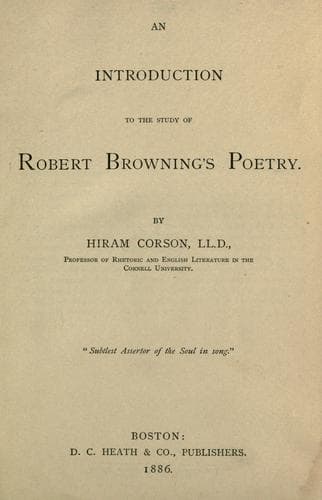
Public-domain text, read in full here on John Shaqi.
An Introduction to the Study of Robert Browning's Poetry — John Shaqi
Reviews
Reviews
No reviews yet
Be the first to share your thoughts on this work.
Elsewhere in the archive
Join the Discussion
Join the discussion
Sign in to leave a comment or review.
Sign InorCreate an account