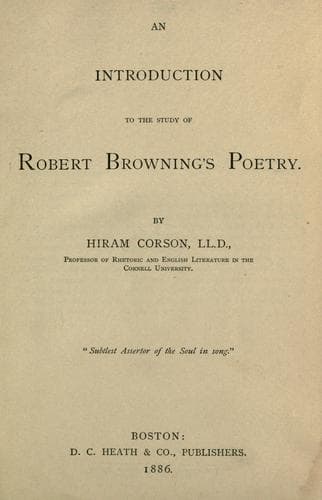
“Abt Vogler has been extemporizing on his instrument,
pouring out through it all his feelings of yearning and aspiration;
and now, waking from his state of absorption, excited,
and trembling with excess of emotion, he breaks out into the wish,
‘Would it might tarry!’ In verses {stanzas} one and two
he compares the music he has made to a palace, which Solomon
(as legends of the Koran relate) summoned all creatures,
by the magic name on his ring, to raise for the princess he loved;
so all the keys, joyfully submitting to the magic power of the master,
combine to aid him, the low notes rushing in like demons to give him
the base on which to build his airy structure; the high notes
like angels throwing decoration of carving and tracery on pinnacle
and flying buttress, till in verse three its outline, rising ever
higher and higher, shows in the clouds like St. Peter’s dome,
illuminated and towering into the vasty sky; and it seems
as if his soul, upborne on the surging waves of music,
had reached its highest elevation. But no. Influences from without,
inexplicable, unexpected, join to enhance his own attempts;
the heavens themselves seem to bow down and to flash forth
inconceivable splendors on his amazed spirit, till the limitations
of time and space are gone--‘there is no more near nor far’.
“. . .In this strange fusion of near and far, of heaven and earth,
presences hover, spirits of those long dead or of those yet to be,
lured by the power of music to return to life, or to begin it.
Figures are dimly descried in the fervor and passion of music,
even as of old in the glare and glow of the fiery furnace.
“Verses four and five are a bold attempt to describe the indescribable,
to shadow forth that strange state of clairvoyance when the soul
shakes itself free from all external impressions, which Vogel tells us
was the case with Schubert, and which is true of all great composers--
‘whether in the body or out of the body, I cannot say’.
“In the sixth verse we come to a comparison of music with
the other arts. Poetry, painting, and sculpture deal with actual form,
and the tangible realities of life. They are subject to laws,
and we know how they are produced; can watch the painting grow
beneath the artist’s touches, or the poem take shape line by line.
“True it needs the soul of the artist to combine and to interfuse
the elements with which he wishes to create any true work of art,
but music is almost entirely independent of earthly element in which
to clothe and embody itself. It does not allow of a realistic conception,
but without intermediate means is in a direct line from God,
and enables us to comprehend that Power which created all things
out of nothing, with whom TO WILL and TO DO are one and the same.
Public-domain text, read in full here on John Shaqi.
Reviews
Reviews
No reviews yet
Be the first to share your thoughts on this work.
Elsewhere in the archive
Join the Discussion
Join the discussion
Sign in to leave a comment or review.
Sign InorCreate an account