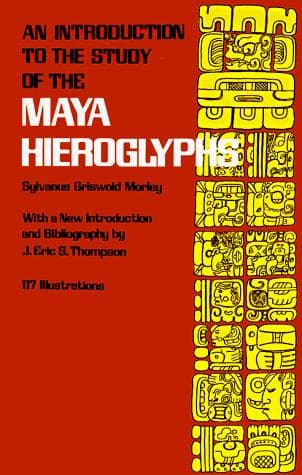
It must be admitted that very little progress has been made in deciphering
the Maya glyphs except those relating to the calendar and chronology; that
is, the signs for the various time periods (days and months), the numerals,
and a few name-glyphs; however, as these known signs comprise possibly
two-fifths of all the glyphs, it is clear that the general tenor of the
Maya inscriptions is no longer concealed from us. The remaining
three-fifths probably tell the nature of the events which occurred on the
corresponding dates, and it is to these we must turn for the subject matter
of Maya history. The deciphering of this textual residuum is enormously
complicated by the character of the Maya glyphs, which for the greater part
are ideographic rather than phonetic; that is, the various symbols
represent ideas rather than sounds.
In a graphic system composed largely of ideographic elements it is
extremely difficult to determine the meanings of the different signs, since
little or no help is to be derived from varying combinations of elements as
in a phonetic system. In phonetic writing the symbols have fixed sounds,
which are unchanging throughout, and when these values have once been
determined, they may be substituted for the characters wherever they occur,
and thus words are formed.
While the Maya glyphs largely represent ideas, indubitable traces of
phoneticism and phonetic composition appear. There are perhaps half a dozen
glyphs in all which are known to be constructed on a purely phonetic basis,
and as the remaining glyphs are gradually deciphered this number will
doubtless be increased.
The progress which has been made in deciphering the Maya inscriptions may
be summarized as follows: The Maya calendar, chronology, and astronomy as
recorded in the hieroglyphic texts have been carefully worked out, and it
is unlikely that future discoveries will change our present conception of
them. There remains, however, a group of glyphs which are probably
non-calendric, non-chronologic, and non-astronomic in character. These, it
may be reasonably expected, will be found to describe the subject matter of
Maya history; that is, they probably set forth the nature of the events
which took place on the dates recorded. An analogy would be the following:
Supposing, in scanning a history of the United States, only the dates could
be read. We would find, for example, July 4, 1776, followed by unknown
characters; April 12, 1861, by others; and March 4, 1912, by others. This,
then, is the case with the Maya glyphs--we find dates followed by glyphs of
unknown meaning, which presumably set forth the nature of the corresponding
events. In a word, we know now the {v} chronologic skeleton of Maya
history; it remains to work out the more intimate details which alone can
make it a vital force.
Public-domain text, read in full here on John Shaqi.
Reviews
Reviews
No reviews yet
Be the first to share your thoughts on this work.
Join the Discussion
Join the discussion
Sign in to leave a comment or review.
Sign InorCreate an account