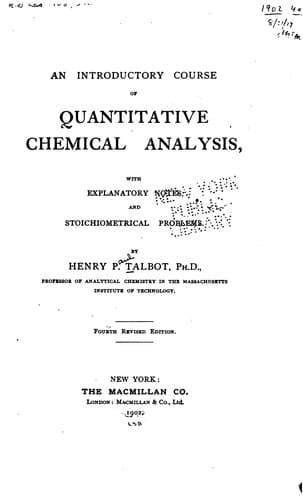
An Introductory Course of Quantitative Chemical Analysis: With Explanatory Notes — John Shaqi
An Introductory Course of Quantitative Chemical Analysis: With Explanatory NotesTalbot, Henry Paul
Science
An Introductory Course of Quantitative Chemical Analysis: With Explanatory Notes
Talbot, Henry Paul
Chemistry, Analytic -- Quantitative
From a somewhat different standpoint the methods in each case may
be subdivided into (a) DIRECT METHODS, in which the substance to be
measured is directly determined by titration to an end-point with a
standard solution; and (b) INDIRECT METHODS, in which the substance
itself is not measured, but a quantity of reagent is added which is
known to be an excess with respect to a specific reaction, and the
unused excess determined by titration. Examples of the latter class
will be pointed out as they occur in the procedures.
MEASURING INSTRUMENTS
THE ANALYTICAL BALANCE
For a complete discussion of the physical principles underlying the
construction and use of balances, and the various methods of weighing,
the student is referred to larger manuals of Quantitative Analysis,
such as those of Fresenius, or Treadwell-Hall, and particularly to
the admirable discussion of this topic in Morse's !Exercises in
Quantitative Chemistry!.
The statements and rules of procedure which follow are sufficient
for the intelligent use of an analytical balance in connection with
processes prescribed in this introductory manual. It is, however,
imperative that the student should make himself familiar with these
essential features of the balance, and its use. He should fully
realize that the analytical balance is a delicate instrument which
will render excellent service under careful treatment, but such
treatment is an essential condition if its accuracy is to be depended
upon. He should also understand that no set of rules, however
complete, can do away with the necessity for a sense of personal
responsibility, since by carelessness he can render inaccurate not
only his own analyses, but those of all other students using the same
balance.
Before making any weighings the student should seat himself before a
balance and observe the following details of construction:
1. The balance case is mounted on three brass legs, which should
preferably rest in glass cups, backed with rubber to prevent slipping.
The front legs are adjustable as to height and are used to level the
balance case; the rear leg is of permanent length.
2. The front of the case may be raised to give access to the balance.
In some makes doors are provided also at the ends of the balance case.
3. The balance beam is mounted upon an upright in the center of the
case on the top of which is an inlaid agate plate. To the center of
the beam there is attached a steel or agate knife-edge on which the
beam oscillates when it rests on the agate plate.
4. The balance beam, extending to the right and left, is graduated
along its upper edge, usually on both sides, and has at its
extremities two agate or steel knife-edges from which are suspended
stirrups. Each of these stirrups has an agate plate which, when the
balance is in action, rests upon the corresponding knife-edge of the
beam. The balance pans are suspended from the stirrups.
Public-domain text, read in full here on John Shaqi.
Reviews
Reviews
No reviews yet
Be the first to share your thoughts on this work.
Join the Discussion
Join the discussion
Sign in to leave a comment or review.
Sign InorCreate an account