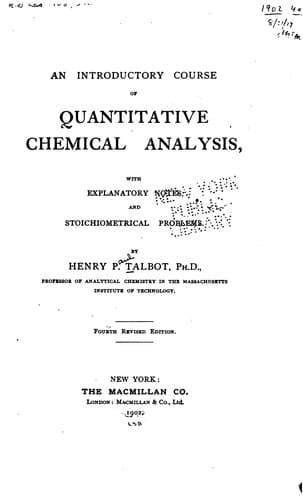
An Introductory Course of Quantitative Chemical Analysis: With Explanatory NotesTalbot, Henry Paul
Science
An Introductory Course of Quantitative Chemical Analysis: With Explanatory Notes
Talbot, Henry Paul
Chemistry, Analytic -- Quantitative
For analytical purposes, solutions of nitrates or sulphates of the
metals are preferable to those of the chlorides, since liberated
chlorine attacks the electrodes. In some cases, as for example, that
of silver, solution of salts forming complex ions, like that of
the double cyanide of silver and potassium, yield better metallic
deposits.
Most metals are deposited as such upon the cathode; a few, notably
lead and manganese, separate in the form of dioxides upon the anode.
It is evidently important that the deposited material should be so
firmly adherent that it can be washed, dried, and weighed without
loss in handling. To secure these conditions it is essential that the
current density (that is, the amount of current per unit of area of
the electrodes) shall not be too high. In prescribing analytical
conditions it is customary to state the current strength in "normal
densities" expressed in amperes per 100 sq. cm. of electrode surface,
as, for example, "N.D_{100} = 2 amps."
If deposition occurs too rapidly, the deposit is likely to be spongy
or loosely adherent and falls off on subsequent treatment. This places
a practical limit to the current density to be employed, for a given
electrode surface. The cause of the unsatisfactory character of
the deposit is apparently sometimes to be found in the coincident
liberation of considerable hydrogen and sometimes in the failure of
the rapidly deposited material to form a continuous adherent surface.
The effect of rotating electrodes upon the character of the deposit is
referred to below.
The negative ions of an electrolyte are attracted to the anode and are
discharged on contact with it. Anions such as the chloride ion yield
chlorine atoms, from which gaseous chlorine molecules are formed
and escape. The radicals which compose such ions as NO_{3}^{-} or
SO_{4}^{--} are not capable of independent existence after discharge,
and break down into oxygen and N_{2}O_{5} and SO_{3} respectively. The
oxygen escapes and the anhydrides, reacting with water, re-form nitric
and sulphuric acids.
Public-domain text, read in full here on John Shaqi.
Reviews
Reviews
No reviews yet
Be the first to share your thoughts on this work.
Elsewhere in the archive
Join the Discussion
Join the discussion
Sign in to leave a comment or review.
Sign InorCreate an account