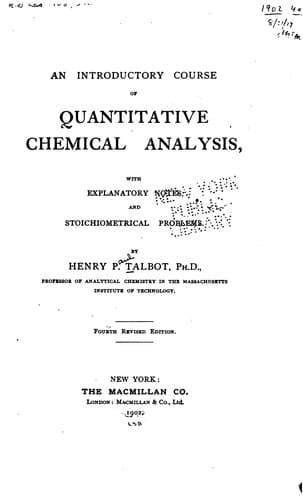
An Introductory Course of Quantitative Chemical Analysis: With Explanatory NotesTalbot, Henry Paul
Science
An Introductory Course of Quantitative Chemical Analysis: With Explanatory Notes
Talbot, Henry Paul
Chemistry, Analytic -- Quantitative
The law of Faraday expresses the relation between current strength and
the quantities of the decomposition products which, under constant
conditions, appear at the electrodes, namely, that a given quantity
of electricity, acting for a given time, causes the separation of
chemically equivalent quantities of the various elements or radicals.
For example, since 107.94 grams of silver is equivalent to 1.008 grams
of hydrogen, and that in turn to 8 grams of oxygen, or 31.78 grams of
copper, the quantity of electricity which will cause the deposit of
107.94 grams of silver in a given time will also separate the weights
just indicated of the other substances. Experiments show that a
current of one ampere passing for one second, i.e., a coulomb of
electricity, causes the deposition of 0.001118 gram of silver from a
normal solution of a silver salt. The number of coulombs required to
deposit 107.94 grams is 107.94/0.001118 or 96,550 and the same number
of coulombs will also cause the separation of 1.008 grams of hydrogen,
8 grams of oxygen or 31.78 grams of copper. While it might at first
appear that Faraday's law could thus be used as a basis for the
calculation of the time required for the deposition of a given
quantity of an electrolyte from solution, it must be remembered that
the law expresses what occurs when the concentration of the ions in
the solution is kept constant, as, for example, when the anode in
a silver salt solution is a plate of metallic silver. Under the
conditions of electro-analysis the concentration of the ions is
constantly diminishing as deposition proceeds and the time actually
required for complete deposition of a given weight of material by
a current of constant strength is, therefore, greater than that
calculated on the basis of the law as stated above.
The electrodes employed in electro-analysis are almost exclusively
of platinum, since that metal alone satisfactorily resists chemical
action of the electrolytes, and can be dried and weighed without
change in composition. The platinum electrodes may be used in the
form of dishes, foil or gauze. The last, on account of the ease of
circulation of the electrolyte, its relatively large surface in
proportion to its weight and the readiness with which it can be washed
and dried, is generally preferred.
Public-domain text, read in full here on John Shaqi.
Reviews
Reviews
No reviews yet
Be the first to share your thoughts on this work.
Elsewhere in the archive
Join the Discussion
Join the discussion
Sign in to leave a comment or review.
Sign InorCreate an account