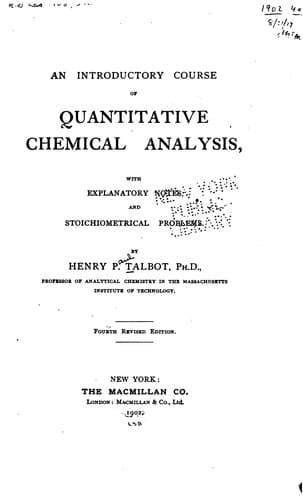
An Introductory Course of Quantitative Chemical Analysis: With Explanatory NotesTalbot, Henry Paul
Science
An Introductory Course of Quantitative Chemical Analysis: With Explanatory Notes
Talbot, Henry Paul
Chemistry, Analytic -- Quantitative
[Note 3: In a carefully neutralized solution containing a considerable
excess of the precipitant, and also ammonium salts, the separation
of the zinc is complete after standing four hours. The ionic changes
connected with the precipitation of the zinc as zinc ammonium
phosphate are similar to those described for magnesium ammonium
phosphate, except that the zinc precipitate is soluble in an excess of
ammonium hydroxide, probably as a result of the formation of complex
ions of the general character Zn(NH_{3})_{4}^{++}.]
[Note 4: The precipitate is washed first with a dilute solution of the
phosphate to prevent a slight decomposition of the precipitate (as a
result of hydrolysis) if hot water alone is used. The alcohol is added
to the final wash-water to promote the subsequent drying.]
[Note 5: The precipitate may be ignited and weighed as
Zn_{2}P_{2}O_{7}, by cautiously heating the porcelain Gooch crucible
within a nickel or iron crucible, used as a radiator. The heating
must be very slow at first, as the escaping ammonia may reduce the
precipitate if it is heated too quickly.]
[Note 6: If the ammonium sulphide produced a distinct precipitate,
this should be collected on a small filter, dissolved in a few cubic
centimeters of dilute nitric acid, and the zinc reprecipitated as
phosphate, filtered off, dried, and weighed, and the weight added to
that of the main precipitate.]
[Note 7: It has been found that some samples of asbestos are acted
upon by the phosphate solution and lose weight. An error from this
source may be avoided by determining the weight of the crucible
and filter after weighing the precipitate. For this purpose the
precipitate may be dissolved in dilute nitric acid, the asbestos
washed thoroughly, and the crucible reweighed.]
[Note 8. The details of this method of precipitation of zinc are fully
discussed in an article by Dakin, !Ztschr. Anal. Chem.!, 39 (1900),
273.]
DETERMINATION OF SILICA IN SILICATES
Of the natural silicates, or artificial silicates such as slags and
some of the cements, a comparatively few can be completely decomposed
by treatment with acids, but by far the larger number require fusion
with an alkaline flux to effect decomposition and solution
for analysis. The procedure given below applies to silicates
undecomposable by acids, of which the mineral feldspar is taken as a
typical example. Modifications of the procedure, which are applicable
to silicates which are completely or partially decomposable by acids,
are given in the Notes on page 155.
PREPARATION OF THE SAMPLE
Public-domain text, read in full here on John Shaqi.
Reviews
Reviews
No reviews yet
Be the first to share your thoughts on this work.
Elsewhere in the archive
Join the Discussion
Join the discussion
Sign in to leave a comment or review.
Sign InorCreate an account