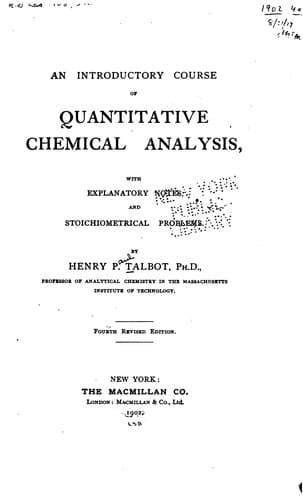
An Introductory Course of Quantitative Chemical Analysis: With Explanatory NotesTalbot, Henry Paul
Science
An Introductory Course of Quantitative Chemical Analysis: With Explanatory Notes
Talbot, Henry Paul
Chemistry, Analytic -- Quantitative
PROCEDURE.--Acidify the filtrate from the iron determination with
dilute nitric acid. Concentrate it to 150 cc. Add to the cold solution
dilute ammonia (sp. gr. 0.96) cautiously until it barely smells of
ammonia; then add !one drop! of a dilute solution of litmus (Note 1),
and drop in, with the aid of a dropper, dilute nitric acid until the
blue of the litmus just changes to red. It is important that this
point should not be overstepped. Heat the solution nearly to boiling
and pour into it slowly a filtered solution of di-ammonium hydrogen
phosphate[1] containing a weight of the phosphate about equal
to twelve times that of the zinc to be precipitated. (For this
calculation the approximate percentage of zinc is that found by
subtracting the sum of the percentages of the copper, lead and iron
from 100 per cent.) Keep the solution just below boiling for fifteen
minutes, stirring frequently (Note 2). If at the end of this time the
amorphous precipitate has become crystalline, allow the solution to
cool for about four hours, although a longer time does no harm (Note
3), and filter upon an asbestos filter in a porcelain Gooch crucible.
The filter is prepared as described on page 103, and should be dried
to constant weight at 105°C.
[Footnote 1: The ammonium phosphate which is commonly obtainable
contains some mono-ammonium salt, and this is not satisfactory as a
precipitant. It is advisable, therefore, to weigh out the amount of
the salt required, dissolve it in a small volume of water, add a drop
of phenolphthalein solution, and finally add dilute ammonium hydroxide
solution cautiously until the solution just becomes pink, but do not
add an excess.]
Wash the precipitate until free from sulphates with a warm 1 per cent
solution of the di-ammonium phosphate, and then five times with 50 per
cent alcohol (Note 4). Dry the crucible and precipitate for an hour at
105°C., and finally to constant weight (Note 5). The filtrate should
be made alkaline with ammonia and tested for zinc with a few drops of
ammonium sulphide, allowing it to stand (Notes 6, 7 and 8).
From the weight of the zinc ammonium phosphate (ZnNH_{4}PO_{4})
calculate the percentage of the zinc (Zn) in the brass.
[Note 1: The zinc ammonium phosphate is soluble both in acids and in
ammonia. It is, therefore, necessary to precipitate the zinc in a
nearly neutral solution, which is more accurately obtained by adding
a drop of a litmus solution to the liquid than by the use of litmus
paper.]
[Note 2: The precipitate which first forms is amorphous, and may have
a variable composition. On standing it becomes crystalline and then
has the composition ZnNH_{4}PO_{4}. The precipitate then settles
rapidly and is apt to occasion "bumping" if the solution is heated to
boiling. Stirring promotes the crystallization.]
Public-domain text, read in full here on John Shaqi.
Reviews
Reviews
No reviews yet
Be the first to share your thoughts on this work.
Elsewhere in the archive
Join the Discussion
Join the discussion
Sign in to leave a comment or review.
Sign InorCreate an account