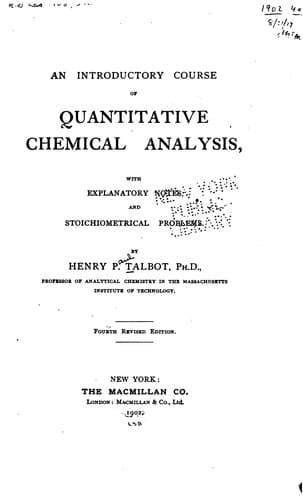
An Introductory Course of Quantitative Chemical Analysis: With Explanatory NotesTalbot, Henry Paul
Science
An Introductory Course of Quantitative Chemical Analysis: With Explanatory Notes
Talbot, Henry Paul
Chemistry, Analytic -- Quantitative
PROCEDURE.--Evaporate the solution of the fusion to dryness, stirring
frequently until the residue is a dry powder. Moisten the residue with
5 cc. of strong hydrochloric acid (sp. gr. 1.20) and evaporate again
to dryness. Heat the residue for at least one hour at a temperature
of 110°C. (Note 1). Again moisten the residue with concentrated
hydrochloric acid, warm gently, making sure that the acid comes into
contact with the whole of the residue, dilute to about 200 cc. and
bring to boiling. Filter off the silica without much delay (Note 2),
and wash five times with warm dilute hydrochloric acid (one part
dilute acid (1.12 sp. gr.) to three parts of water). Allow the filter
to drain for a few moments, then place a clean beaker below the funnel
and wash with water until free from chlorides, discarding these
washings. Evaporate the original filtrate to dryness, dehydrate at
110°C. for one hour (Note 3), and proceed as before, using a second
filter to collect the silica after the second dehydration. Wash this
filter with warm, dilute hydrochloric acid (Note 4), and finally with
hot water until free from chlorides.
[Note 1: The silicic acid must be freed from its combination with
a base (sodium, in this instance) before it can be dehydrated.
The excess of hydrochloric acid accomplishes this liberation. By
disintegrating the fused mass with a considerable volume of dilute
acid the silicic acid is at first held in solution to a large extent.
Immediate treatment of the fused mass with strong acid is likely
to cause a semi-gelatinous silicic acid to separate at once and to
inclose alkali salts or alumina.
A flocculent residue will often remain after the decomposition of the
fused mass is effected. This is usually partially dehydrated silicic
acid and does not require further treatment at this point. The
progress of the dehydration is indicated by the behavior of the
solution, which as evaporation proceeds usually gelatinizes. On this
account it is necessary to allow the solution to evaporate on a steam
bath, or to stir it vigorously, to avoid loss by spattering.]
[Note 2: To obtain an approximately pure silica, the residue after
evaporation must be thoroughly extracted by warming with hydrochloric
acid, and the solution freely diluted to prevent, as far as possible,
the inclosure of the residual salts in the particles of silica. The
filtration should take place without delay, as the dehydrated silica
slowly dissolves in hydrochloric acid on standing.]
[Note 3: It has been shown by Hillebrand that silicic acid cannot be
completely dehydrated by a single evaporation and heating, nor by
several such treatments, unless an intermediate filtration of the
silica occurs. If, however, the silica is removed and the filtrates
are again evaporated and the residue heated, the amount of silica
remaining in solution is usually negligible, although several
evaporations and filtrations are required with some silicates to
insure absolute accuracy.
Public-domain text, read in full here on John Shaqi.
Reviews
Reviews
No reviews yet
Be the first to share your thoughts on this work.
Elsewhere in the archive
Join the Discussion
Join the discussion
Sign in to leave a comment or review.
Sign InorCreate an account