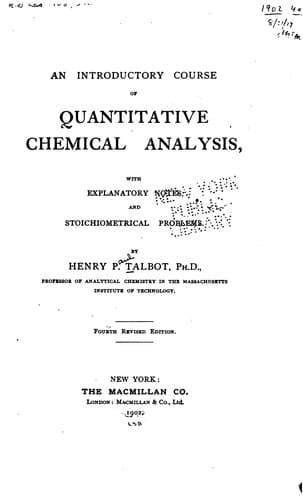
An Introductory Course of Quantitative Chemical Analysis: With Explanatory NotesTalbot, Henry Paul
Science
An Introductory Course of Quantitative Chemical Analysis: With Explanatory Notes
Talbot, Henry Paul
Chemistry, Analytic -- Quantitative
It is probable that temperatures above 100°C. are not absolutely
necessary to dehydrate the silica; but it is recommended, as tending
to leave the silica in a better condition for filtration than when
the lower temperature of the water bath is used. This, and many other
points in the analysis of silicates, are fully discussed by Dr.
Hillebrand in the admirable monograph on "The Analysis of Silicate and
Carbonate Rocks," Bulletin No. 700 of the United States Geological
Survey.
The double evaporation and filtration spoken of above are essential
because of the relatively large amount of alkali salts (sodium
chloride) present after evaporation. For the highest accuracy in the
determination of silica, or of iron and alumina, it is also necessary
to examine for silica the precipitate produced in the filtrate by
ammonium hydroxide by fusing it with acid potassium sulphate and
solution of the fused mass in water. The insoluble silica is filtered,
washed, and weighed, and the weight added to the weight of silica
previously obtained.]
[Note 4: Aluminium and iron are likely to be thrown down as basic
salts from hot, very dilute solutions of their chlorides, as a result
of hydrolysis. If the silica were washed only with hot water, the
solution of these chlorides remaining in the filter after the passage
of the original filtrate would gradually become so dilute as to throw
down basic salts within the pores of the filter, which would remain
with the silica. To avoid this, an acid wash-water is used until the
aluminium and iron are practically removed. The acid is then removed
by water.]
IGNITION AND TESTING OF SILICA
PROCEDURE.--Transfer the two washed filters belonging to each
determination to a platinum crucible, which need not be previously
weighed, and burn off the filter (Note 1). Ignite for thirty minutes
over the blast lamp with the cover on the crucible, and then for
periods of ten minutes, until the weight is constant.
When a constant weight has been obtained, pour into the crucible about
3 cc. of water, and then 3 cc. of hydrofluoric acid. !This must be
done in a hood with a good draft and great care must be taken not to
come into contact with the acid or to inhale its fumes (Note 2!).
If the precipitate has dissolved in this quantity of acid, add two
drops of concentrated sulphuric acid, and heat very slowly (always
under the hood) until all the liquid has evaporated, finally igniting
to redness. Cool in a desiccator, and weigh the crucible and residue.
Deduct this weight from the previous weight of crucible and impure
silica, and from the difference calculate the percentage of silica in
the sample (Note 3).
Public-domain text, read in full here on John Shaqi.
Reviews
Reviews
No reviews yet
Be the first to share your thoughts on this work.
Elsewhere in the archive
Join the Discussion
Join the discussion
Sign in to leave a comment or review.
Sign InorCreate an account