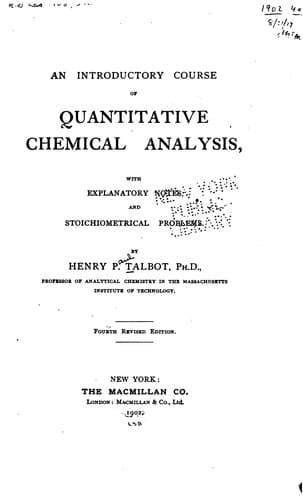
An Introductory Course of Quantitative Chemical Analysis: With Explanatory NotesTalbot, Henry Paul
Science
An Introductory Course of Quantitative Chemical Analysis: With Explanatory Notes
Talbot, Henry Paul
Chemistry, Analytic -- Quantitative
The problems with which the analytical chemist has to deal are not, as
a matter of actual fact, difficult either to solve or to understand.
That they appear difficult to many students is due to the fact that,
instead of understanding the principles which underlie each of the
small number of types into which these problems may be grouped, each
problem is approached as an individual puzzle, unrelated to others
already solved or explained. This attitude of mind should be carefully
avoided.
It is obvious that ability to make the calculations necessary for
the interpretation of analytical data is no less important than the
manipulative skill required to obtain them, and that a moderate time
spent in the careful study of the solutions of the typical problems
which follow may save much later embarrassment.
1. It is often necessary to calculate what is known as a "chemical
factor," or its equivalent logarithmic value called a "log factor,"
for the conversion of the weight of a given chemical substance into an
equivalent weight of another substance. This is, in reality, a very
simple problem in proportion, making use of the atomic or molecular
weights of the substances in question which are chemically equivalent
to each other. One of the simplest cases of this sort is the
following: What is the factor for the conversion of a given weight of
barium sulphate (BaSO_{4}) into an equivalent weight of sulphur (S)?
The molecular weight of BaSO_{4} is 233.5. There is one atom of S in
the molecule and the atomic weight of S is 32.1. The chemical factor
is, therefore, 32.1/233.5, or 0.1375 and the weight of S corresponding
to a given weight of BaSO_{4} is found by multiplying the weight of
BaSO_{4} by this factor. If the problem takes the form, "What is
the factor for the conversion of a given weight of ferric oxide
(Fe_{2}O_{3}) into ferrous oxide (FeO), or of a given weight of
mangano-manganic oxide (Mn_{3}O_{4}) into manganese (Mn)?" the
principle involved is the same, but it must then be noted that, in the
first instance, each molecule of Fe_{2}O_{3} will be equivalent to two
molecules of FeO, and in the second instance that each molecule of
Mn_{3}O_{4} is equivalent to three atoms of Mn. The respective factors
then become
(2FeO/Fe_{2}O_{3}) or (143.6/159.6) and (3Mn/Mn_{3}O_{4}) or
(164.7/228.7).
It is obvious that the arithmetical processes involved in this type
of problem are extremely simple. It is only necessary to observe
carefully the chemical equivalents. It is plainly incorrect to express
the ratio of ferrous to ferric oxide as (FeO/Fe_{2}O_{3}), since each
molecule of the ferric oxide will yield two molecules of the ferrous
oxide. Mistakes of this sort are easily made and constitute one of the
most frequent sources of error.
Public-domain text, read in full here on John Shaqi.
Reviews
Reviews
No reviews yet
Be the first to share your thoughts on this work.
Elsewhere in the archive
Join the Discussion
Join the discussion
Sign in to leave a comment or review.
Sign InorCreate an account