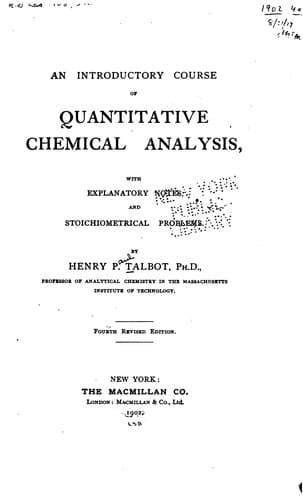
An Introductory Course of Quantitative Chemical Analysis: With Explanatory NotesTalbot, Henry Paul
Science
An Introductory Course of Quantitative Chemical Analysis: With Explanatory Notes
Talbot, Henry Paul
Chemistry, Analytic -- Quantitative
[Note 1: The silica undergoes no change during the ignition beyond the
removal of all traces of water; but Hillebrand (!loc. cit.!) has shown
that the silica holds moisture so tenaciously that prolonged ignition
over the blast lamp is necessary to remove it entirely. This finely
divided, ignited silica tends to absorb moisture, and should be
weighed quickly.]
[Note 2: Notwithstanding all precautions, the ignited precipitate of
silica is rarely wholly pure. It is tested by volatilisation of the
silica as silicon fluoride after solution in hydrofluoric acid, and,
if the analysis has been properly conducted, the residue, after
treatment with the acids and ignition, should not exceed 1 mg.
The acid produces ulceration if brought into contact with the skin,
and its fumes are excessively harmful if inhaled.]
[Note 3: The impurities are probably weighed with the original
precipitate in the form of oxides. The addition of the sulphuric
acid displaces the hydrofluoric acid, and it may be assumed that the
resulting sulphates (usually of iron or aluminium) are converted to
oxides by the final ignition.
It is obvious that unless the sulphuric and hydrofluoric acids used
are known to leave no residue on evaporation, a quantity equal to that
employed in the analysis must be evaporated and a correction applied
for any residue found.]
[Note 4: If the silicate to be analyzed is shown by a previous
qualitative examination to be completely decomposable, it may be
directly treated with hydrochloric acid, the solution evaporated to
dryness, and the silica dehydrated and further treated as described in
the case of the feldspar after fusion.
A silicate which gelatinizes on treatment with acids should be mixed
first with a little water, and the strong acid added in small portions
with stirring, otherwise the gelatinous silicic acid incloses
particles of the original silicate and prevents decomposition. The
water, by separating the particles and slightly lessening the rapidity
of action, prevents this difficulty. This procedure is one which
applies in general to the solution of fine mineral powders in acids.
If a small residue remains undecomposed by the treatment of the
silicate with acid, this may be filtered, washed, ignited and fused
with sodium carbonate and a solution of the fused mass added to the
original acid solution. This double procedure has an advantage, in
that it avoids adding so large a quantity of sodium salts as is
required for disintegration of the whole of the silicate by the fusion
method.]
PART IV
STOICHIOMETRY
Public-domain text, read in full here on John Shaqi.
Reviews
Reviews
No reviews yet
Be the first to share your thoughts on this work.
Elsewhere in the archive
Join the Discussion
Join the discussion
Sign in to leave a comment or review.
Sign InorCreate an account