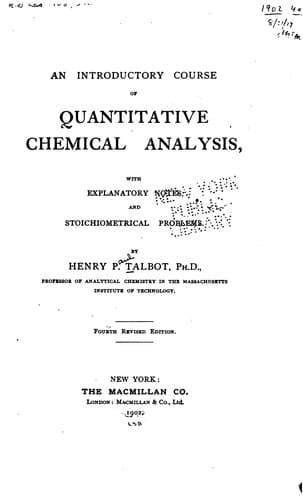
An Introductory Course of Quantitative Chemical Analysis: With Explanatory NotesTalbot, Henry Paul
Science
An Introductory Course of Quantitative Chemical Analysis: With Explanatory Notes
Talbot, Henry Paul
Chemistry, Analytic -- Quantitative
95. What weight of impure calcite (CaCO_{3}) should be taken for
analysis so that the volume in cubic centimeters of CO_{2} obtained by
treating with acid, measured dry at 18°C. and 763 mm., shall equal the
percentage of CaO in the sample?
!Answer!: 0.2359 gram.
96. How many cubic centimeters of HNO_{3} (sp. gr. 1.13 containing
21.0% HNO_{3} by weight) are required to dissolve 5 grams of brass,
containing 0.61% Pb, 24.39% Zn, and 75% Cu, assuming reduction of the
nitric acid to NO by each constituent? What fraction of this volume of
acid is used for oxidation?
!Answers!: 55.06 cc.; 25%.
97. What weight of metallic copper will be deposited from a cupric
salt solution by a current of 1.5 amperes during a period of 45
minutes, assuming 100% current efficiency? (1 Faraday = 96,500
coulombs.)
!Answer!: 1.335 grams.
98. In the electrolysis of a 0.8000 gram sample of brass, there is
obtained 0.0030 gram of PbO_{2}, and a deposit of metallic copper
exactly equal in weight to the ignited precipitate of Zn_{2}P_{2}O_{7}
subsequently obtained from the solution. What is the percentage
composition of the brass?
!Answers!: 69.75% Cu; 29.92% Zn; 0.33% Pb.
99. A sample of brass (68.90% Cu; 1.10% Pb and 30.00% Zn) weighing
0.9400 gram is dissolved in nitric acid. The lead is determined by
weighing as PbSO_{4}, the copper by electrolysis and the zinc by
precipitation with (NH_{4})_{2}HPO_{4} in a neutral solution.
(a) Calculate the cubic centimeters of nitric acid (sp. gr. 1.42
containing 69.90% HNO_{3} by weight) required to just dissolve the
brass, assuming reduction to NO.
!Answer!: 2.48 cc.
(b) Calculate the cubic centimeters of sulphuric acid (sp. gr. 1.84
containing 94% H_{2}SO_{4} by weight) to displace the nitric acid.
!Answer!: 0.83 cc.
(c) Calculate the weight of PbSO_{4}.
!Answer!: 0.0152 gram.
(d) The clean electrode weighs 10.9640 grams. Calculate the weight
after the copper has been deposited.
!Answer!: 11.6116 grams.
(e) Calculate the grams of (NH_{4})_{2}HPO_{4} required to precipitate
the zinc as ZnNH_{4}PO_{4}.
!Answer!: 0.5705 gram.
(f) Calculate the weight of ignited Zn_{2}P_{2}O_{7}.
!Answer!: 0.6573 gram.
100. If in the analysis of a brass containing 28.00% zinc an error is
made in weighing a 2.5 gram portion by which 0.001 gram too much is
weighed out, what percentage error in the zinc determination would
result? What volume of a solution of sodium hydrogen phosphate,
containing 90 grams of Na_{2}HPO_{4}.12H_{2}O per liter, would be
required to precipitate the zinc as ZnNH_{4}PO_{4} and what weight of
precipitate would be obtained?
!Answers!: (a) 0.04% error; (b) 39.97 cc.; (c) 1.909 grams.
101. A sample of magnesium carbonate, contaminated with SiO_{2} as its
only impurity, weighs 0.5000 gram and loses 0.1000 gram on ignition.
What volume of disodium phosphate solution (containing 90 grams
Na_{2}HPO_{4}.12H_{2}O per liter) will be required to precipitate the
magnesium as magnesium ammonium phosphate?
Public-domain text, read in full here on John Shaqi.
Reviews
Reviews
No reviews yet
Be the first to share your thoughts on this work.
Elsewhere in the archive
Join the Discussion
Join the discussion
Sign in to leave a comment or review.
Sign InorCreate an account