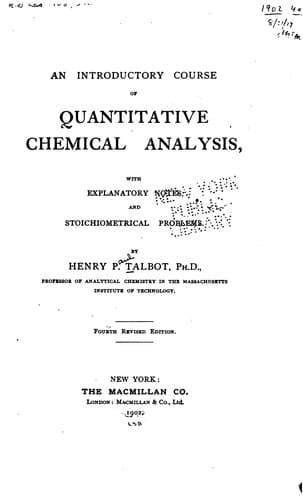
An Introductory Course of Quantitative Chemical Analysis: With Explanatory NotesTalbot, Henry Paul
Science
An Introductory Course of Quantitative Chemical Analysis: With Explanatory Notes
Talbot, Henry Paul
Chemistry, Analytic -- Quantitative
!Answer!: 9.07 cc.
102. 2.62 cubic centimeters of nitric acid (sp. gr. 1.42 containing
69.80% HNO_{2} by weight) are required to just dissolve a sample
of brass containing 69.27% Cu; 0.05% Pb; 0.07% Fe; and 30.61% Zn.
Assuming the acid used as oxidizing agent was reduced to NO in every
case, calculate the weight of the brass and the cubic centimeters of
acid used as acid.
!Answer!: 0.992 gram; 1.97 cc.
103. One gram of a mixture of silver chloride and silver bromide is
found to contain 0.6635 gram of silver. What is the percentage of
bromine?
!Answer!: 21.30%.
104. A precipitate of silver chloride and silver bromide weighs 0.8132
gram. On heating in a current of chlorine, the silver bromide is
converted to silver chloride, and the mixture loses 0.1450 gram
in weight. Calculate the percentage of chlorine in the original
precipitate.
!Answer!: 6.13%.
105. A sample of feldspar weighing 1.000 gram is fused and the silica
determined. The weight of silica is 0.6460 gram. This is fused with 4
grams of sodium carbonate. How many grams of the carbonate actually
combined with the silica in fusion, and what was the loss in weight
due to carbon dioxide during the fusion?
!Answers!: 1.135 grams; 0.4715 gram.
106. A mixture of barium oxide and calcium oxide weighing 2.2120 grams
is transformed into mixed sulphates, weighing 5.023 grams. Calculate
the grams of calcium oxide and barium oxide in the mixture.
!Answers!: 1.824 grams CaO; 0.3877 gram BaO.
APPENDIX
ELECTROLYTIC DISSOCIATION THEORY
The following brief statements concerning the ionic theory and a few
of its applications are intended for reference in connection with the
explanations which are given in the Notes accompanying the various
procedures. The reader who desires a more extended discussion of the
fundamental theory and its uses is referred to such books as Talbot
and Blanchard's !Electrolytic Dissociation Theory! (Macmillan
Company), or Alexander Smith's !Introduction to General Inorganic
Chemistry! (Century Company).
The !electrolytic dissociation theory!, as propounded by Arrhenius in
1887, assumes that acids, bases, and salts (that is, electrolytes)
in aqueous solution are dissociated to a greater or less extent into
!ions!. These ions are assumed to be electrically charged atoms or
groups of atoms, as, for example, H^{+} and Br^{-} from hydrobromic
acid, Na^{+} and OH^{-} from sodium hydroxide, 2NH_{4}^{+} and
SO_{4}^{--} from ammonium sulphate. The unit charge is that which is
dissociated with a hydrogen ion. Those upon other ions vary in sign
and number according to the chemical character and valence of the
atoms or radicals of which the ions are composed. In any solution the
aggregate of the positive charges upon the positive ions (!cations!)
must always balance the aggregate negative charges upon the negative
ions (!anions!).
Public-domain text, read in full here on John Shaqi.
Reviews
Reviews
No reviews yet
Be the first to share your thoughts on this work.
Elsewhere in the archive
Join the Discussion
Join the discussion
Sign in to leave a comment or review.
Sign InorCreate an account