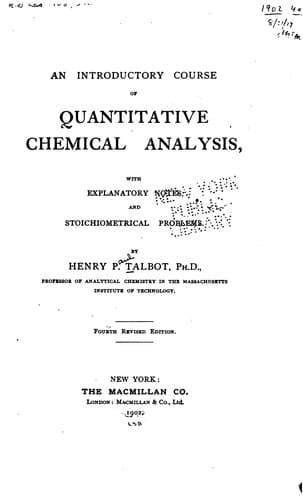
An Introductory Course of Quantitative Chemical Analysis: With Explanatory NotesTalbot, Henry Paul
Science
An Introductory Course of Quantitative Chemical Analysis: With Explanatory Notes
Talbot, Henry Paul
Chemistry, Analytic -- Quantitative
That which is true of this reaction is also true of all reversible
reactions, namely, that any change of conditions which occasions
an increase or a decrease in concentration of one or more of the
components causes the reaction to proceed in one direction or the
other until a new state of equilibrium is established. This principle
is constantly applied throughout the discussion of the applications
of the ionic theory in analytical chemistry, and it should be clearly
understood that whenever an existing state of equilibrium is disturbed
as a result of changes of dilution or temperature, or as a consequence
of chemical changes which bring into action any of the constituents of
the solution, thus altering their concentrations, there is always a
tendency to re-establish this equilibrium in accordance with the law.
Thus, if a base is added to the solution of acetic acid the H^{+} ions
then unite with the OH^{-} ions from the base to form undissociated
water. The concentration of the H^{+} ions is thus diminished, and
more of the acid dissociates in an attempt to restore equilbrium,
until finally practically all the acid is dissociated and neutralized.
Similar conditions prevail when, for example, silver ions react with
chloride ions, or barium ions react with sulphate ions. In the former
case the dissociation reaction of the silver nitrate is AgNO_{3} <-->
Ag^{+} + NO_{3}^{-}, and as soon as the Ag^{+} ions unite with the
Cl^{-} ions the concentration of the former is diminished, more of the
AgNO_{3} dissociates, and this process goes on until the Ag^{+} ions
are practically all removed from the solution, if the Cl^{-} ions are
present in sufficient quantity.
For the sake of accuracy it should be stated that the mass law cannot
be rigidly applied to solutions of those electrolytes which are
largely dissociated. While the explanation of the deviation from
quantitative exactness in these cases is not known, the law is still
of marked service in developing analytical methods along more logical
lines than was formerly practicable. It has not seemed wise to qualify
each statement made in the Notes to indicate this lack of quantitative
exactness. The student should recognize its existence, however, and
will realize its significance better as his knowledge of physical
chemistry increases.
If we apply the mass law to the case of a substance of small
solubility, such as the compounds usually precipitated in quantitative
analysis, we derive what is known as the !solubility product!, as
follows: Taking silver chloride as an example, and remembering that it
is not absolutely insoluble in water, the equilibrium expression for
its solution is:
(!Conc'n Ag^{+} x Conc'n Cl^{-})/Conc'n AgCl = Constant!.
Public-domain text, read in full here on John Shaqi.
Reviews
Reviews
No reviews yet
Be the first to share your thoughts on this work.
Elsewhere in the archive
Join the Discussion
Join the discussion
Sign in to leave a comment or review.
Sign InorCreate an account