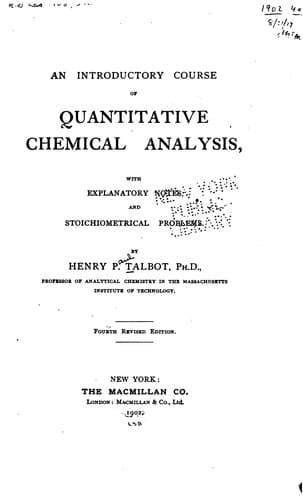
An Introductory Course of Quantitative Chemical Analysis: With Explanatory NotesTalbot, Henry Paul
Science
An Introductory Course of Quantitative Chemical Analysis: With Explanatory Notes
Talbot, Henry Paul
Chemistry, Analytic -- Quantitative
But such a solution of silver chloride which is in contact with the
solid precipitate must be saturated for the existing temperature, and
the quantity of undissociated AgCl in the solution is definite and
constant for that temperature. Since it is a constant, it may be
eliminated, and the expression becomes !Conc'n Ag^{+} x Conc'n
Cl^{-} = Constant!, and this is known as the solubility product. No
precipitation of a specific substance will occur until the product of
the concentrations of its ions in a solution exceeds the solubility
product for that substance; whenever that product is exceeded
precipitation must follow.
It will readily be seen that if a substance which yields an ion in
common with the precipitated compound is added to such a solution as
has just been described, the concentration of that ion is
increased, and as a result the concentration of the other ion must
proportionately decrease, which can only occur through the formation
of some of the undissociated compound which must separate from the
already saturated solution. This explains why the addition of an
excess of the precipitant is often advantageous in quantitative
procedures. Such a case is discussed at length in Note 2 on page 113.
Similarly, the ionization of a specific substance in solution tends to
diminish on the addition of another substance with a common ion, as,
for instance, the addition of hydrochloric acid to a solution
of hydrogen sulphide. Hydrogen sulphide is a weak acid, and the
concentration of the hydrogen ions in its aqueous solutions is very
small. The equilibrium in such a solution may be represented as:
(!(Conc'n H^{+})^{2} x Conc'n S^{--})/Conc'n H_{2}S = Constant!, and a
marked increase in the concentration of the H^{+} ions, such as would
result from the addition of even a small amount of the highly ionized
hydrochloric acid, displaces the point of equilibrium and some of the
S^{--} ions unite with H^{+} ions to form undissociated H_{2}S. This
is of much importance in studying the reactions in which hydrogen
sulphide is employed, as in qualitative analysis. By a parallel course
of reasoning it will be seen that the addition of a salt of a weak
acid or base to solutions of that acid or base make it, in effect,
still weaker because they decrease its percentage ionization.
Public-domain text, read in full here on John Shaqi.
Reviews
Reviews
No reviews yet
Be the first to share your thoughts on this work.
Elsewhere in the archive
Join the Discussion
Join the discussion
Sign in to leave a comment or review.
Sign InorCreate an account