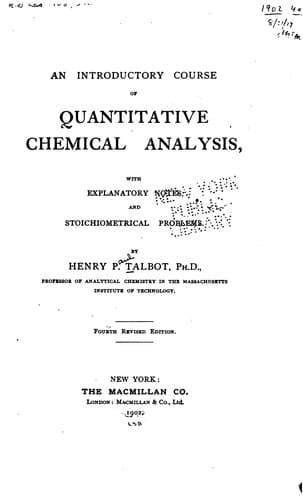
An Introductory Course of Quantitative Chemical Analysis: With Explanatory Notes — John Shaqi
An Introductory Course of Quantitative Chemical Analysis: With Explanatory NotesTalbot, Henry Paul
Science
An Introductory Course of Quantitative Chemical Analysis: With Explanatory Notes
Talbot, Henry Paul
Chemistry, Analytic -- Quantitative
It has already been pointed out that the purpose of an indicator is to
mark (usually by a change of color) the point at which just enough of
the titrating solution has been added to complete the chemical change
which it is intended to bring about. In the neutralization processes
which are employed in the measurement of alkalies (!alkalimetry!)
or acids (!acidimetry!) the end-point of the reaction should, in
principle, be that of complete neutrality. Expressed in terms of ionic
reactions, it should be the point at which the H^{+} ions from an
acid[Note 1] unite with a corresponding number of OH^{-} ions from a
base to form water molecules, as in the equation
H^{+}, Cl^{-} + Na^{+}, OH^{-} --> Na^{+}, Cl^{-} + (H_{2}O).
It is not usually possible to realize this condition of exact
neutrality, but it is possible to approach it with sufficient
exactness for analytical purposes, since substances are known which,
in solution, undergo a sharp change of color as soon as even a minute
excess of H^{+} or OH^{-} ions are present. Some, as will be seen,
react sharply in the presence of H^{+} ions, and others with OH^{-}
ions. These substances employed as indicators are usually organic
compounds of complex structure and are closely allied to the dyestuffs
in character.
[Note 1: A knowledge on the part of the student of the ionic theory
as applied to aqueous solutions of electrolytes is assumed. A brief
outline of the more important applications of the theory is given in
the Appendix.]
BEHAVIOR OF ORGANIC INDICATORS
The indicators in most common use for acid and alkali titrations are
methyl orange, litmus, and phenolphthalein.
In the following discussion of the principles underlying the behavior
of the indicators as a class, methyl orange and phenolphthalein will
be taken as types. It has just been pointed out that indicators are
bodies of complicated structure. In the case of the two indicators
named, the changes which they undergo have been carefully studied by
Stieglitz (!J. Am. Chem. Soc.!, 25, 1112) and others, and it appears
that the changes involved are of two sorts: First, a rearrangement
of the atoms within the molecule, such as often occurs in organic
compounds; and, second, ionic changes. The intermolecular changes
cannot appropriately be discussed here, as they involve a somewhat
detailed knowledge of the classification and general behavior of
organic compounds; they will, therefore, be merely alluded to, and
only the ionic changes followed.
Methyl orange is a representative of the group of indicators which,
in aqueous solutions, behave as weak bases. The yellow color which it
imparts to solutions is ascribed to the presence of the undissociated
base. If an acid, such as HCl, is added to such a solution, the acid
reacts with the indicator (neutralizes it) and a salt is formed, as
indicated by the equation:
(M.o.)^{+}, OH^{-} + H^{+}, Cl^{-} --> (M.o.)^{+} Cl^{-} + (H_{2}O).
Public-domain text, read in full here on John Shaqi.
Reviews
Reviews
No reviews yet
Be the first to share your thoughts on this work.
Join the Discussion
Join the discussion
Sign in to leave a comment or review.
Sign InorCreate an account