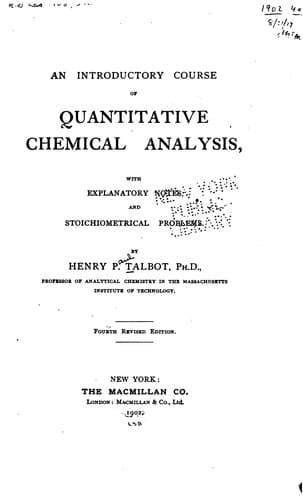
An Introductory Course of Quantitative Chemical Analysis: With Explanatory NotesTalbot, Henry Paul
Science
An Introductory Course of Quantitative Chemical Analysis: With Explanatory Notes
Talbot, Henry Paul
Chemistry, Analytic -- Quantitative
[Note 1: In the foregoing procedure the acid solution is standardized
and the alkali solution referred to this standard by calculation. It
is equally possible, if preferred, to standardize the alkali solution.
The standards in a common use for this purpose are purified
oxalic acid (H_{2}C_{2}O_{4}.2H_{2}O), potassium acid oxalate
(KHC_{2}O_{4}.H_{2}O or KHC_{2}O_{4}), potassium tetroxalate
(KHC_{2}O_{4}.H_{2}C_{2}O_{4}.2H_{2}O), or potassium acid tartrate
(KHC_{4}O_{6}), with the use of a suitable indicator. The oxalic acid
and the oxalates should be specially prepared to insure purity,
the main difficulty lying in the preservation of the water of
crystallization.
It should be noted that the acid oxalate and the acid tartrate each
contain one hydrogen atom replaceable by a base, while the tetroxalate
contains three such atoms and the oxalic acid two. Each of the two
salts first named behave, therefore, as monobasic acids, and the
tetroxalate as a tribasic acid.]
[Note 2: It is also possible to standardize a hydrochloric acid
solution by precipitating the chloride ions as silver chloride and
weighing the precipitate, as prescribed under the analysis of sodium
chloride to be described later. Sulphuric acid solutions may be
standardized by precipitation of the sulphate ions as barium sulphate
and weighing the ignited precipitate, but the results are not above
criticism on account of the difficulty in obtaining large precipitates
of barium sulphate which are uncontaminated by inclosures or are not
reduced on ignition.]
DETERMINATION OF THE TOTAL ALKALINE STRENGTH OF SODA ASH
Soda ash is crude sodium carbonate. If made by the ammonia process it
may contain also sodium chloride, sulphate, and hydroxide; when made
by the Le Blanc process it may contain sodium sulphide, silicate, and
aluminate, and other impurities. Some of these, notably the hydroxide,
combine with acids and contribute to the total alkaline strength,
but it is customary to calculate this strength in terms of sodium
carbonate; i.e., as though no other alkali were present.
Public-domain text, read in full here on John Shaqi.
Reviews
Reviews
No reviews yet
Be the first to share your thoughts on this work.
Join the Discussion
Join the discussion
Sign in to leave a comment or review.
Sign InorCreate an account