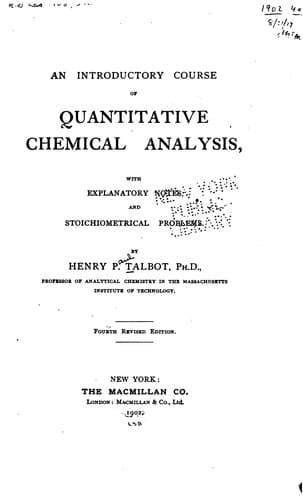
An Introductory Course of Quantitative Chemical Analysis: With Explanatory NotesTalbot, Henry Paul
Science
An Introductory Course of Quantitative Chemical Analysis: With Explanatory Notes
Talbot, Henry Paul
Chemistry, Analytic -- Quantitative
[Note 2: A determination of the alkali present as hydroxide in soda
ash may be determined by precipitating the carbonate by the addition
of barium chloride, removing the barium carbonate by filtration, and
titrating the alkali in the filtrate.
The caustic alkali may also be determined by first using
phenolphthalein as an indicator, which will show by its change from
pink to colorless the point at which the caustic alkali has been
neutralized and the carbonate has been converted to bicarbonate, and
then adding methyl orange and completing the titration. The amount of
acid necessary to change the methyl orange to pink is a measure of one
half of the carbonate present. The results of the double titration
furnish the data necessary for the determination of the caustic alkali
and of the carbonate in the sample.]
DETERMINATION OF THE ACID STRENGTH OF OXALIC ACID
PROCEDURE.--Weigh out two portions of the acid of about 1 gram
each. Dissolve these in 50 cc. of warm water. Add two drops of
phenolphthalein solution, and run in alkali from the burette until the
solution is pink; add acid from the other burette until the pink is
just destroyed, and then add 0.3 cc. (not more) in excess. Heat the
solution to boiling for three minutes. If the pink returns during the
boiling, discharge it with acid and again add 0.3 cc. in excess and
repeat the boiling (Note 1). If the color does not then reappear, add
alkali until it does, and a !drop or two! of acid in excess and boil
again for one minute (Note 2). If no color reappears during this time,
complete the titration in the hot solution. The end-point should be
the faintest visible shade of color (or its disappearance), as the
same difficulty would exist here as with methyl orange if an attempt
were made to match shades of pink.
From the corrected volume of alkali required to react with the
oxalic acid, calculate the percentage of the crystallized acid
(H_{2}C_{2}O_{4}.2H_{2}O) in the sample (Note 3).
[Note 1: All commercial caustic soda such as that from which the
standard solution was made contains some sodium carbonate. This reacts
with the oxalic acid, setting free carbonic acid, which, in turn,
forms sodium bicarbonate with the remaining carbonate:
H_{2}CO_{3} + Na_{2}CO_{3} --> 2HNaCO_{3}.
This compound does not hydrolyze sufficiently to furnish enough OH^{-}
ions to cause phenolphthalein to remain pink; hence, the color of
the indicator is discharged in cold solutions at the point at which
bicarbonate is formed. If, however, the solution is heated to boiling,
the bicarbonate loses carbon dioxide and water, and reverts to sodium
carbonate, which causes the indicator to become again pink:
2HNaCO_{3} --> H_{2}O + CO_{2} + Na_{2}CO_{3}.
By adding successive portions of hydrochloric acid and boiling, the
carbonate is ultimately all brought into reaction.
The student should make sure that the difference in behavior of the
two indicators, methyl orange and phenolphthalein, is understood.]
Public-domain text, read in full here on John Shaqi.
Reviews
Reviews
No reviews yet
Be the first to share your thoughts on this work.
Join the Discussion
Join the discussion
Sign in to leave a comment or review.
Sign InorCreate an account