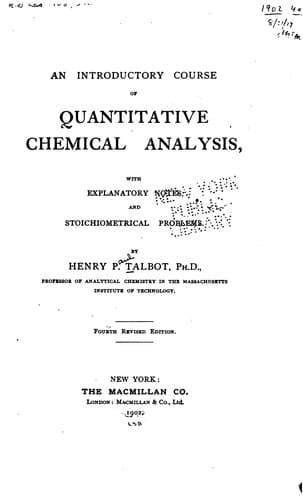
An Introductory Course of Quantitative Chemical Analysis: With Explanatory NotesTalbot, Henry Paul
Science
An Introductory Course of Quantitative Chemical Analysis: With Explanatory Notes
Talbot, Henry Paul
Chemistry, Analytic -- Quantitative
Ferrous salts may be promptly and completely oxidized to ferric salts,
even in cold solution, by the addition of potassium bichromate,
provided sufficient acid is present to hold in solution the ferric and
chromic compounds which are formed.
The acid may be either hydrochloric or sulphuric, but the former is
usually preferred, since it is by far the best solvent for iron and
its compounds. The reaction in the presence of hydrochloric acid is as
follows:
6FeCl_{2} + K_{2}Cr_{2}O_{7} + 14HCl --> 6FeCl_{3} + 2CrCl_{3} + 2KCl
+ 7H_{2}O.
NORMAL SOLUTIONS OF OXIDIZING OR REDUCING AGENTS
It will be recalled that the system of normal solutions is based upon
the equivalence of the reagents which they contain to 8 grams of
oxygen or 1 gram of hydrogen. A normal solution of an oxidizing agent
should, therefore, contain that amount per liter which is equivalent
in oxidizing power to 8 grams of oxygen; a normal reducing solution
must be equivalent in reducing power to 1 gram of hydrogen. In order
to determine what the amount per liter will be it is necessary to know
how the reagents enter into reaction. The two solutions to be employed
in the process under consideration are those of potassium bichromate
and ferrous sulphate. The reaction between them, in the presence of an
excess of sulphuric acid, may be expressed as follows:
6FeSO_{4} + K_{2}Cr_{2}O_{7} + 7H_{2}SO_{4} --> 3Fe_{2}(SO_{4})_{3} +
K_{2}SO_{4} + Cr_{2}(SO_{4})_{3} + 7H_{2}O.
If the compounds of iron and chromium, with which alone we are now
concerned, be written in such a way as to show the oxides of these
elements in each, they would appear as follows: On the left-hand side
of the equation 6(FeO.SO_{3}) and K_{2}O.2CrO_{3}; on the right-hand
side, 3(Fe_{2}O_{3}.3SO_{3}) and Cr_{2}O_{3}.3SO_{3}. A careful
inspection shows that there are three less oxygen atoms associated
with chromium atoms on the right-hand side of the equation than on the
left-hand, but there are three more oxygen atoms associated with iron
atoms on the right than on the left. In other words, a molecule of
potassium bichromate has given up three atoms of oxygen for oxidation
purposes; i.e., a molecular weight in grams of the bichromate (294.2)
will furnish 3 X 16 or 48 grams of oxygen for oxidation purposes.
As this 48 grams is six times 8 grams, the basis of the system, the
normal solution of potassium bichromate should contain per liter one
sixth of 294.2 grams or 49.03 grams.
A further inspection of the dissected compounds above shows that six
molecules of FeO.SO_{3} were required to react with the three atoms of
oxygen from the bichromate. From the two equations
3H_{2} + 3O --> 3H_{2}O
6(FeO.SO_{3}) + 3O --> 3(Fe_{2}O_{3}.3SO_{3})
Public-domain text, read in full here on John Shaqi.
Reviews
Reviews
No reviews yet
Be the first to share your thoughts on this work.
Join the Discussion
Join the discussion
Sign in to leave a comment or review.
Sign InorCreate an account