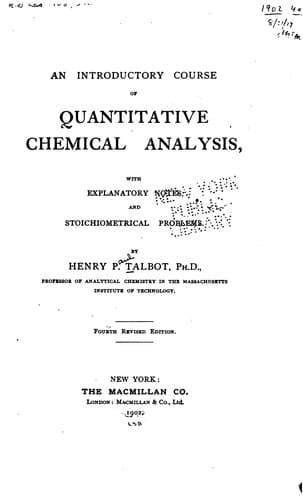
An Introductory Course of Quantitative Chemical Analysis: With Explanatory NotesTalbot, Henry Paul
Science
An Introductory Course of Quantitative Chemical Analysis: With Explanatory Notes
Talbot, Henry Paul
Chemistry, Analytic -- Quantitative
Commercial iodine is usually not sufficiently pure to permit of its
use as a standard for thiosulphate solutions or the direct preparation
of a standard solution of iodine. It is likely to contain, beside
moisture, some iodine chloride, if chlorine was used to liberate the
iodine when it was prepared. It may be purified by sublimation after
mixing it with a little potassium iodide, which reacts with the iodine
chloride, forming potassium chloride and setting free the iodine. The
sublimed iodine is then dried by placing it in a closed container over
concentrated sulphuric acid. It may then be weighed in a stoppered
weighing-tube and dissolved in a solution of potassium iodide in a
stoppered flask to prevent loss of iodine by volatilization. About 18
grams of the iodide and twelve grams of iodine per liter are required
for an approximately tenth-normal solution.
An iodine solution made from commercial iodine may also be
standardized against arsenious oxide (As_{4}O_{6}). This substance
also usually requires purification by sublimation before use.
The substances usually employed for the standardization of a
thiosulphate solution are potassium bromate and metallic copper. The
former is obtainable in pure condition or may be easily purified by
re-crystallization. Copper wire of high grade is sufficiently pure
to serve as a standard. Both potassium bromate and cupric salts in
solution will liberate iodine from an iodide, which is then titrated
with the thiosulphate solution.
The reactions involved are the following:
(a) KBrO_{3} + 6KI + 3H_{2}SO_{4} --> KBr + 3I_{2} + 3K_{2}SO_{4} + 3H_{2}O,
(b) 3Cu + 8HNO_{3} --> 3Cu(NO_{3})_{2} + 2NO + 4H_{2}O,
2Cu(NO_{3})_{2} + 4KI --> 2CuI + 4KNO_{3} + I_{2}.
Two methods for the direct standardization of the sodium thiosulphate
solution are here described, and one for the direct standardization of
the iodine solution.
!Method A!
PROCEDURE.--Weigh out into 500 cc. beakers two portions of about
0.150-0.175 gram of potassium bromate. Dissolve each of these in 50
cc. of water, and add 10 cc. of a potassium iodide solution containing
3 grams of the salt in that volume (Note 1). Add to the mixture 10 cc.
of dilute sulphuric acid (1 volume of sulphuric acid with 5 volumes of
water), allow the solution to stand for three minutes, and dilute to
150 cc. (Note 2). Run in thiosulphate solution from a burette until
the color of the liberated iodine is nearly destroyed, and then add 1
cc. or 2 cc. of starch solution, titrate to the disappearance of the
iodo-starch blue, and finally add iodine solution until the color
is just restored. Make a blank test for the amount of thiosulphate
solution required to react with the iodine liberated by the iodate
which is generally present in the potassium iodide solution, and
deduct this from the total volume used in the titration.
Public-domain text, read in full here on John Shaqi.
Reviews
Reviews
No reviews yet
Be the first to share your thoughts on this work.
Elsewhere in the archive
Join the Discussion
Join the discussion
Sign in to leave a comment or review.
Sign InorCreate an account