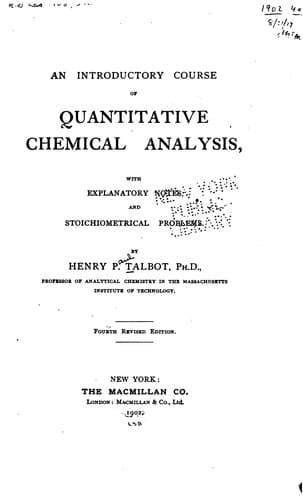
An Introductory Course of Quantitative Chemical Analysis: With Explanatory NotesTalbot, Henry Paul
Science
An Introductory Course of Quantitative Chemical Analysis: With Explanatory Notes
Talbot, Henry Paul
Chemistry, Analytic -- Quantitative
From the data obtained, calculate the relation of the thiosulphate
solution to a normal solution, and subsequently calculate the similar
value for the iodine solution.
[Note 1:--Potassium iodide usually contains small amounts of potassium
iodate as impurity which, when the iodide is brought into an acid
solution, liberates iodine, just as does the potassium bromate used as
a standard. It is necessary to determine the amount of thiosulphate
which reacts with the iodine thus liberated by making a "blank test"
with the iodide and acid alone. As the iodate is not always uniformly
distributed throughout the iodide, it is better to make up a
sufficient volume of a solution of the iodide for the purposes of the
work in hand, and to make the blank test by using the same volume of
the iodide solution as is added in the standardizing process. The
iodide solution should contain about 3 grams of the salt in 10 cc.]
[Note 2: The color of the iodo-starch is somewhat less satisfactory in
concentrated solutions of the alkali salts, notably the iodides. The
dilution prescribed obviates this difficulty.]
!Method B!
PROCEDURE.--Weigh out two portions of 0.25-0.27 gram of clean copper
wire into 250 cc. Erlenmeyer flasks (Note 1). Add to each 5 cc. of
concentrated nitric acid (sp. gr. 1.42) and 25 cc. of water, cover,
and warm until solution is complete. Add 5 cc. of bromine water and
boil until the excess of bromine is expelled. Cool, and add strong
ammonia (sp. gr. 0.90) drop by drop until a deep blue color indicates
the presence of an excess. Boil the solution until the deep blue is
replaced by a light bluish green, or a brown stain appears on the
sides of the flask (Note 2). Add 10 cc. of strong acetic acid (sp.
gr. 1.04), cool under the water tap, and add a solution of potassium
iodide (Note 3) containing about 3 grams of the salt, and titrate
with thiosulphate solution until the color of the liberated iodine
is nearly destroyed. Then add 1-2 cc. of freshly prepared starch
solution, and add thiosulphate solution, drop by drop, until the blue
color is discharged.
From the data obtained, including the "blank test" of the iodide,
calculate the relation of the thiosulphate solution to the normal.
[Note 1: While copper wire of commerce is not absolutely pure, the
requirements for its use as a conductor of electricity are such that
the impurities constitute only a few hundredths of one per cent and
are negligible for analytical purposes.]
[Note 2: Ammonia neutralizes the free nitric acid. It should be added
in slight excess only, since the excess must be removed by boiling,
which is tedious. If too much ammonia is present when acetic acid is
added, the resulting ammonium acetate is hydrolyzed, and the ammonium
hydroxide reacts with the iodine set free.]
Public-domain text, read in full here on John Shaqi.
Reviews
Reviews
No reviews yet
Be the first to share your thoughts on this work.
Elsewhere in the archive
Join the Discussion
Join the discussion
Sign in to leave a comment or review.
Sign InorCreate an account