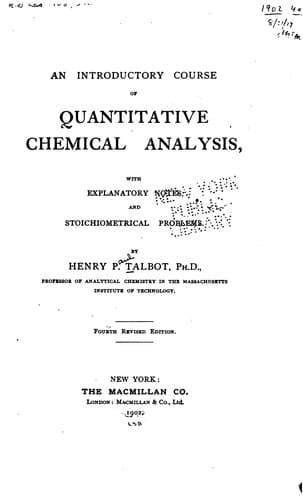
An Introductory Course of Quantitative Chemical Analysis: With Explanatory NotesTalbot, Henry Paul
Science
An Introductory Course of Quantitative Chemical Analysis: With Explanatory Notes
Talbot, Henry Paul
Chemistry, Analytic -- Quantitative
PROCEDURE.-- Weigh out two portions of about 0.5 gram each of the
ore (which should be ground until no grit is detected) into 250 cc.
Erlenmeyer flasks or small beakers. Add 10 cc. of concentrated nitric
acid (sp. gr. 1.42) and heat very gently until the ore is decomposed
and the acid evaporated nearly to dryness (Note 1). Add 5 cc. of
concentrated hydrochloric acid (sp. gr. 1.2) and warm gently. Then
add about 7 cc. of concentrated sulphuric acid (sp. gr. 1.84) and
evaporate over a free flame until the sulphuric acid fumes freely
(Note 2). It has then displaced nitric and hydrochloric acid from
their compounds.
Cool the flask or beaker, add 25 cc. of water, heat the solution
to boiling, and boil for two minutes. Filter to remove insoluble
sulphates, silica and any silver that may have been precipitated as
silver chloride, and receive the filtrate in a small beaker, washing
the precipitate and filter paper with warm water until the filtrate
and washings amount to 75 cc. Bend a strip of aluminium foil (5 cm. x
12 cm.) into triangular form and place it on edge in the beaker. Cover
the beaker and boil the solution (being careful to avoid loss of
liquid by spattering) for ten minutes, but do not evaporate to small
volume.
Wash the cover glass and sides of the beaker. The copper should now be
in the form of a precipitate at the bottom of the beaker or adhering
loosely to the aluminium sheet. Remove the sheet, wash it carefully
with hydrogen sulphide water and place it in a small beaker. Decant
the solution through a filter, wash the precipitated copper twice by
decantation with hydrogen sulphide water, and finally transfer the
copper to the filter paper, where it is again washed thoroughly, being
careful at all times to keep the precipitated copper covered with the
wash water. Remove and discard the filtrate and place an Erlenmeyer
flask under the funnel. Pour 15 cc. of dilute nitric acid (sp. gr.
1.20) over the aluminium foil in the beaker, thus dissolving any
adhering copper. Wash the foil with hot water and remove it. Warm this
nitric acid solution and pour it slowly through the filter paper,
thereby dissolving the copper on the paper, receiving the acid
solution in the Erlenmeyer flask. Before washing the paper, pour 5 cc.
of saturated bromine water (Note 3) through it and finally wash the
paper carefully with hot water and transfer any particles of copper
which may be left on it to the Erlenmeyer flask. Boil to expel the
bromine. Add concentrated ammonia drop by drop until the appearance of
a deep blue coloration indicates an excess. Boil until the deep blue
is displaced by a light bluish green coloration, or until brown stains
form on the sides of the flask. Add 10 cc. of strong acetic acid (Note
4) and cool under the water tap. Add a solution containing about 3
grams of potassium iodide, as in the standardization, and titrate with
thiosulphate solution until the yellow of the liberated iodine is
nearly discharged. Add 1-2 cc.
Public-domain text, read in full here on John Shaqi.
Reviews
Reviews
No reviews yet
Be the first to share your thoughts on this work.
Elsewhere in the archive
Join the Discussion
Join the discussion
Sign in to leave a comment or review.
Sign InorCreate an account