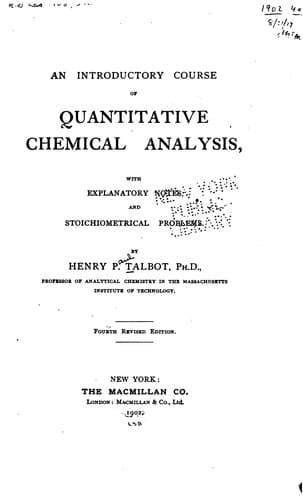
An Introductory Course of Quantitative Chemical Analysis: With Explanatory NotesTalbot, Henry Paul
Science
An Introductory Course of Quantitative Chemical Analysis: With Explanatory Notes
Talbot, Henry Paul
Chemistry, Analytic -- Quantitative
of freshly prepared starch solution and
titrate to the disappearance of the blue color.
From the data obtained, calculate the percentage of copper (Cu) in the
ore.
[Note 1: Nitric acid, because of its oxidizing power, is used as a
solvent for the sulphide ores. As a strong acid it will also dissolve
the copper from carbonate ores. The hydrochloric acid is added to
dissolve oxides of iron and to precipitate silver and lead. The
sulphuric acid displaces the other acids, leaving a solution
containing sulphates only. It also, by its dehydrating action, renders
silica from silicates insoluble.]
[Note 2: Unless proper precautions are taken to insure the correct
concentrations of acid the copper will not precipitate quantitatively
on the aluminium foil; hence care must be taken to follow directions
carefully at this point. Lead and silver have been almost completely
removed as sulphate and chloride respectively, or they too would
be precipitated on the aluminium. Bismuth, though precipitated on
aluminium, has no effect on the analysis. Arsenic and antimony
precipitate on aluminium and would interfere with the titration if
allowed to remain in the lower state of oxidation.]
[Note 3: Bromine is added to oxidize arsenious and antimonious
compounds from the original sample, and to oxidize nitrous acid formed
by the action of nitric acid on copper and copper sulphide.]
[Note 4: This reaction can be carried out in the presence of sulphuric
and hydrochloric acids as well as acetic acid, but in the presence
of these strong acids arsenic and antimonic acids may react with the
hydriodic acid produced with the liberation of free iodine, thereby
reversing the process and introducing an error.]
DETERMINATION OF ANTIMONY IN STIBNITE
Stibnite is native antimony sulphide. Nearly pure samples of this
mineral are easily obtainable and should be used for practice, since
many impurities, notably iron, seriously interfere with the accurate
determination of the antimony by iodometric methods. It is, moreover,
essential that the directions with respect to amounts of reagents
employed and concentration of solutions should be followed closely.
PROCEDURE.--Grind the mineral with great care, and weigh out two
portions of 0.35-0.40 gram into small, dry beakers (100 cc.).
Cover the beakers and pour over the stibnite 5 cc. of concentrated
hydrochloric acid (sp. gr. 1.20) and warm gently on the water bath
(Note 1). When the residue is white, add to each beaker 2 grams of
powdered tartaric acid (Note 2). Warm the solution on the water bath
for ten minutes longer, dilute the solution very cautiously by adding
water in portions of 5 cc., stopping if the solution turns red. It
is possible that no coloration will appear, in which case cautiously
continue the dilution to 125 cc. If a red precipitate or coloration
does appear, warm the solution until it is colorless, and again dilute
cautiously to a total volume of 125 cc. and boil for a minute (Note
3).
Public-domain text, read in full here on John Shaqi.
Reviews
Reviews
No reviews yet
Be the first to share your thoughts on this work.
Elsewhere in the archive
Join the Discussion
Join the discussion
Sign in to leave a comment or review.
Sign InorCreate an account