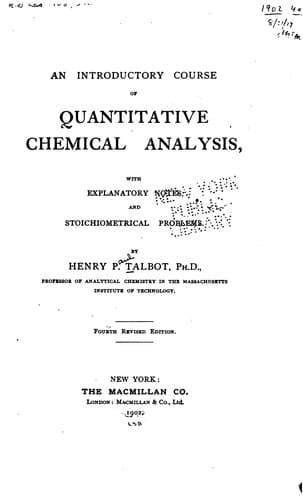
An Introductory Course of Quantitative Chemical Analysis: With Explanatory NotesTalbot, Henry Paul
Science
An Introductory Course of Quantitative Chemical Analysis: With Explanatory Notes
Talbot, Henry Paul
Chemistry, Analytic -- Quantitative
From the corrected volume of the thiocyanate solution required,
calculate the percentage of silver in the coin.
[Note 1: The reaction with silver may be carried out in nitric acid
solutions and in the presence of copper, if the latter does not exceed
70 per cent. Above that percentage it is necessary to add silver in
known quantity to the solution. The liquid must be cold at the time of
titration and entirely free from nitrous compounds, as these sometimes
cause a reddening of the indicator solution. All utensils, distilled
water, the nitric acid and the beakers must be free from chlorides,
as the presence of these will cause precipitation of silver chloride,
thereby introducing an error.]
[Note 2: The solution containing the silver precipitate, as well as
those from the standardization, should be placed in the receptacle for
"silver residues" as a matter of economy.]
PART III
GRAVIMETRIC ANALYSIS
GENERAL DIRECTIONS
Gravimetric analyses involve the following principal steps: first, the
weighing of the sample; second, the solution of the sample; third, the
separation of some substance from solution containing, or bearing a
definite relation to, the constituent to be measured, under conditions
which render this separation as complete as possible; and finally,
the segregation of that substance, commonly by filtration, and the
determination of its weight, or that of some stable product formed
from it on ignition. For example, the gravimetric determination of
aluminium is accomplished by solution of the sample, by precipitation
in the form of hydroxide, collection of the hydroxide upon a filter,
complete removal by washing of all foreign soluble matter, and the
burning of the filter and ignition of the precipitate to aluminium
oxide, in which condition it is weighed.
Among the operations which are common to nearly all gravimetric
analyses are precipitation, washing of precipitates, ignition of
precipitates, and the use of desiccators. In order to avoid burdensome
repetitions in the descriptions of the various gravimetric procedures
which follow, certain general instructions are introduced at this
point. These instructions must, therefore, be considered to be as much
a part of all subsequent procedures as the description of apparatus,
reagents, or manipulations.
The analytical balance, the fundamentally important instrument in
gravimetric analysis, has already been described on pages 11 to 15.
PRECIPITATION
For successful quantitative precipitations those substances are
selected which are least soluble under conditions which can be easily
established, and which separate from solution in such a state that
they can be filtered readily and washed free from admixed material.
In general, the substances selected are the same as those already
familiar to the student of Qualitative Analysis.
Public-domain text, read in full here on John Shaqi.
Reviews
Reviews
No reviews yet
Be the first to share your thoughts on this work.
Elsewhere in the archive
Join the Discussion
Join the discussion
Sign in to leave a comment or review.
Sign InorCreate an account